
First Thorium-229 Nuclear Clocks Achieve Breakthrough Precision
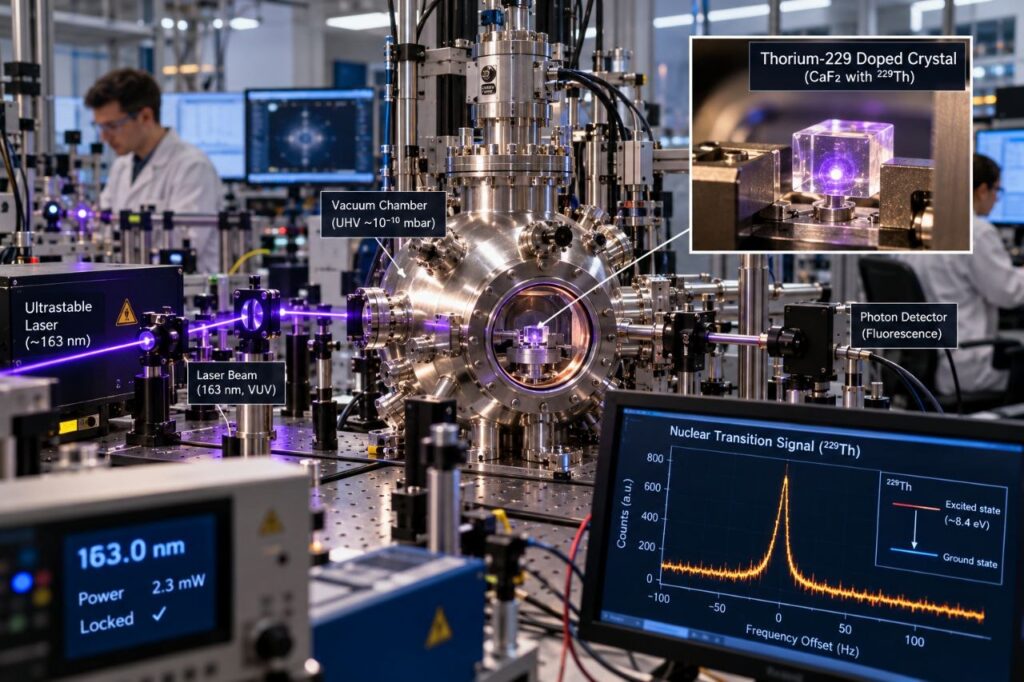
In a milestone achievement for fundamental physics, independent research teams have successfully built and operated the world’s first working nuclear clocks. Utilizing the unique properties of the thorium-229 isotope, these advanced devices promise to surpass the accuracy of modern atomic clocks, opening up unprecedented avenues for testing the laws of physics, measuring time, and detecting subtle shifts in gravity.
The Science Behind Thorium-229 Nuclear Timekeeping
Traditional atomic clocks measure time by tracking the frequency of light required to transition electrons between energy levels. In contrast, nuclear clocks rely on transitions within the atomic nucleus itself. Because the nucleus is tightly bound and largely shielded from external environmental electromagnetic fields, it offers extraordinary stability.
For decades, harnessing nuclear transitions for timekeeping remained out of reach because the required energy levels were far too high for existing lasers. However, the thorium-229 isotope presents a rare exception. Its first excited nuclear state lies at an exceptionally low energy level, requiring vacuum-ultraviolet laser light with a wavelength near 148 nanometers—a threshold that modern laser technology can successfully reach.
Independent Teams Achieve Historic Milestones
The breakthrough was realized by separate research collaborations. One team, led by Luca Toscani De Col and colleagues at the Vienna Center for Quantum Science and Technology in Austria, successfully implemented a thorium-229 optical nuclear clock featuring a continuous feedback loop. Concurrently, a research group led by Beichen Huang and colleagues at Tsinghua University in China, alongside other participating institutes, demonstrated synchronized nuclear clock designs.
The findings, detailed in prominent scientific publications including the journal Nature, mark the transition of nuclear clocks from theoretical proposals—first put forward in 2003 by physicists Ekkehard Peik and Christian Tamm—into fully functional experimental devices.
Future Implications and Challenges
While the successful operation of the first nuclear clocks represents a monumental leap forward, researchers note that several practical challenges remain. The specific thorium-229 isotope required for these devices is scarce, currently sourced primarily from legacy nuclear materials, meaning that improving material efficiency and developing portable designs will be critical next steps for the scientific community.
Despite these supply hurdles, the arrival of nuclear timekeeping provides physicists with a powerful new tool. Researchers anticipate that these ultra-precise instruments will enable tighter constraints on physical constants over time, advance geodetic surveying, and facilitate unprecedented tests of Einstein’s general relativity.