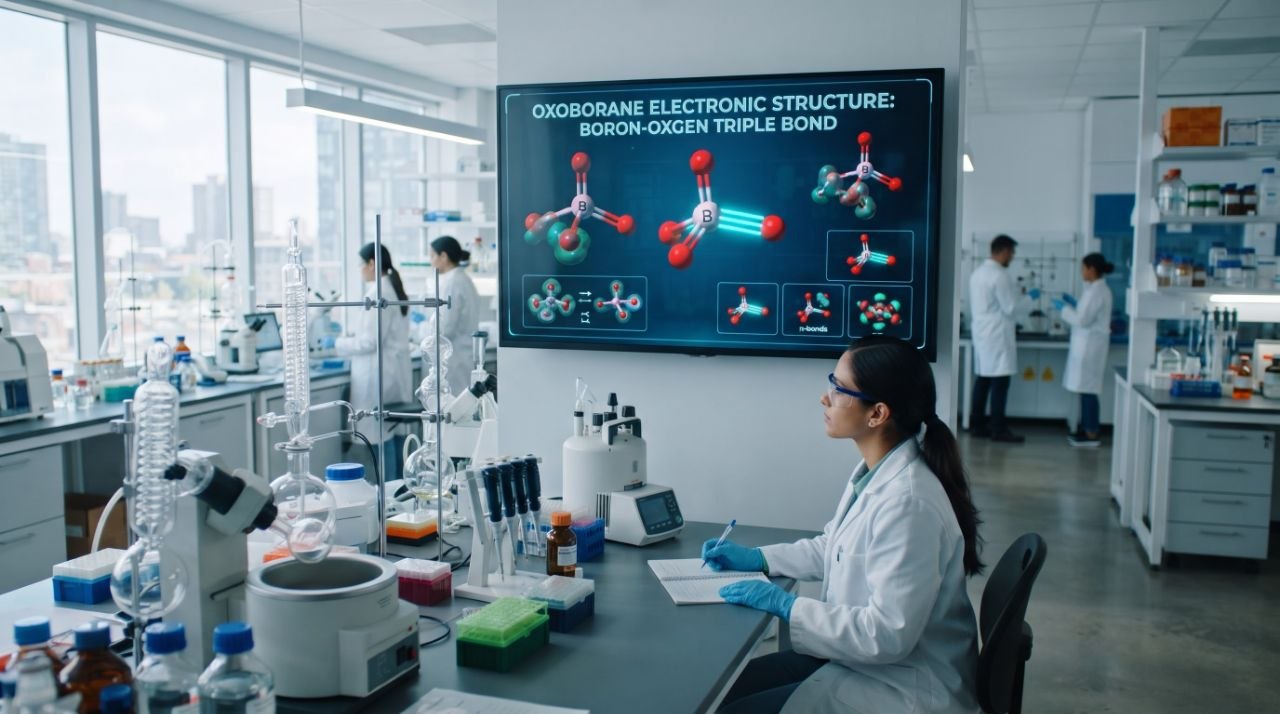
A chemical mystery that baffled researchers for more than six decades has finally been solved. Chemists at the University of Würzburg have successfully prepared and isolated stable oxoboranes—elusive compounds featuring boron-oxygen triple bonds that many scientists had long believed were too unstable to exist in a lasting, isolable form.
A Six-Decade Quest in Main-Group Chemistry
Documented attempts to synthesize organic oxoboranes stretch back to the early 1960s. For decades, successes were fleeting, limited to gas-phase or matrix-isolation experiments, indirect chemical trapping evidence, or derivatives where stabilizing Lewis acids and bases reduced the bond order. Because boron has a strong natural tendency to avoid forming triple bonds, nearly everyone in the field had eventually given up on capturing them in a stable state.
However, a research team led by Professor Holger Braunschweig persisted. Braunschweig has spent over 15 years investigating complex chemical bonding involving boron. His laboratory previously achieved major milestones in the field, reporting the first molecule with a boron-boron triple bond in 2012, followed by the first neutral molecule featuring a boron-carbon triple bond in 2025.
With the isolation of stable oxoboranes, the final remaining challenge involving triple bonds between boron and other first-row p-block elements of the periodic table has been accomplished.
Understanding the Elusive Oxoboranes
Published in the journal Nature Chemistry, the new study details how the research team successfully synthesized a range of these stable molecules at room temperature. Oxoboranes are characterized by a dicoordinate boron atom joined to a monocoordinate oxygen atom.
Advanced computational support conducted alongside the study revealed critical insights into the nature of the chemical bond. Calculations indicate that the boron-oxygen triple bond is considerably ionic in nature, with oxygen contributing significantly more than boron to the bonding orbitals.
This breakthrough closes a historic chapter in main-group chemistry, completing the known roster of stable neutral triple bonds among the first-row p-block elements—boron, carbon, nitrogen, and oxygen—and opening new pathways for fundamental chemical research.