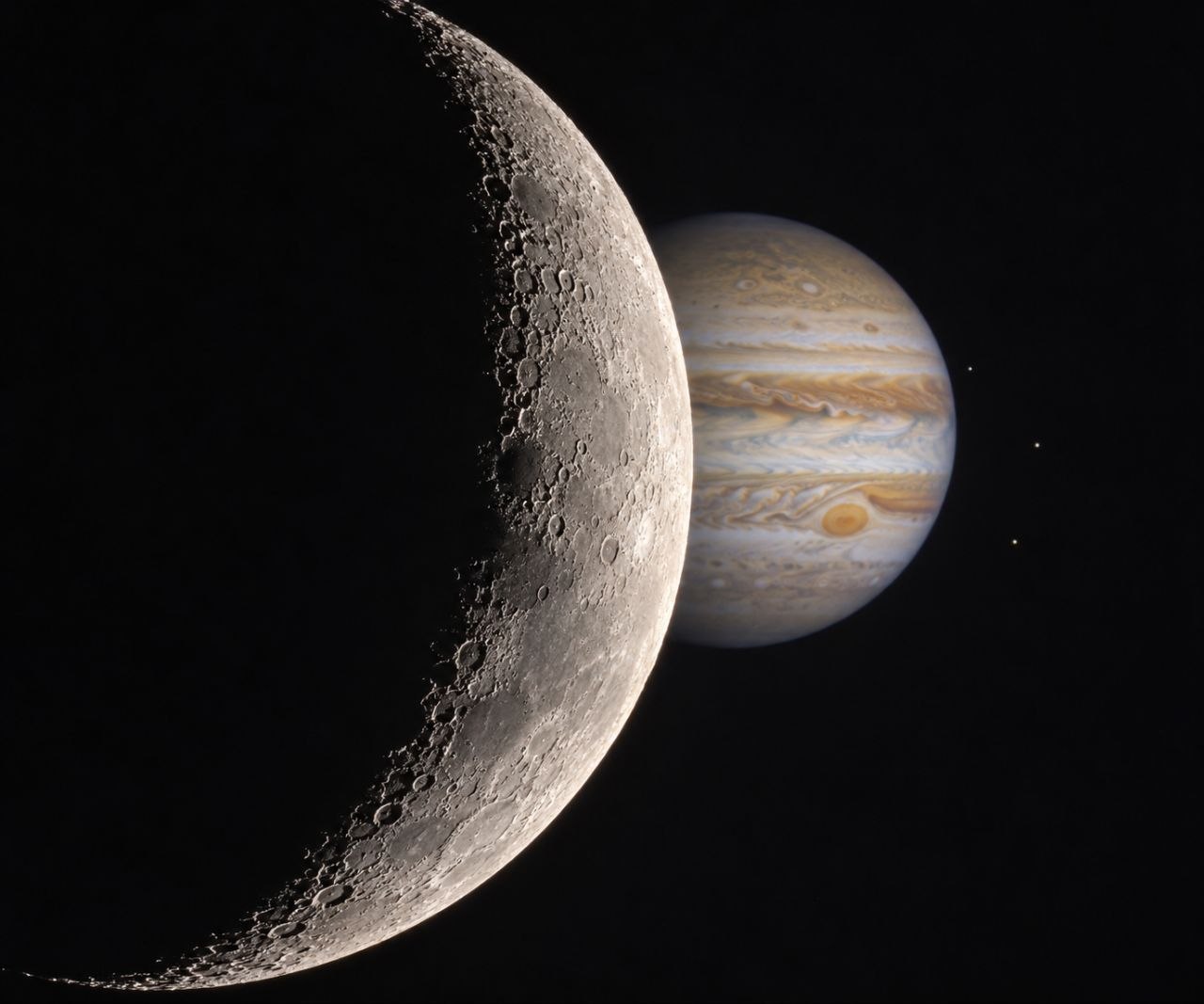
Skywatchers across parts of North America and Africa are preparing for a rare and striking celestial alignment as a waning crescent Moon passes directly in front of the solar system’s largest planet. The upcoming lunar occultation of Jupiter is scheduled for the early morning hours of Tuesday, October 6, 2026, offering a brilliant spectacle for amateur astronomers and casual observers alike.
An occultation occurs when an astronomical object passes between an observer and another distant body, temporarily obscuring it from view. During this event, Jupiter will disappear completely behind the non-lit, earth-lit dark limb of the crescent Moon before eventually sliding back into view.
Viewing Times and Regional Visibility
The exact timing, duration, and angle of approach for the October 2026 Jupiter occultation will vary depending on the observer’s geographic location. For many regions in North America, the event takes place during the pre-dawn hours of October 6.
According to astronomical guides, approach phases begin around 3:06 AM CDT in Chicago and 4:11 AM EDT in Albany, New York, with the actual occultation beginning shortly after. For instance, viewers in the New York area can watch the celestial event unfold between approximately 2:20 AM and 7:30 AM local time using night sky mapping tools. Observers further east across the Atlantic, including parts of Africa such as Dakar, Senegal, will witness the occultation later in the morning around 9:54 AM UTC.
Along certain southern limits—such as Cockburn Harbour on South Caicos Island—observers will experience a grazing occultation, where Jupiter is only partially covered along the Moon’s southern cusp for a brief period.
How to Observe the Planet and Moon Alignment
While the event can be tracked with the naked eye under clear skies within the path of visibility, experts recommend using optical aids to fully appreciate the details. A long focal length telescope or a pair of astronomy binoculars with moderate to high magnification will provide a much clearer view of Jupiter and its Galilean moons as they slip behind and emerge from behind the lunar disk.
In addition to the occultation itself, stargazers using telescopes early in the week can catch related phenomena. For example, a double shadow transit on Jupiter is documented for October 5, 2026, while single shadow transits involving Jupiter’s moons occur close to the time of the occultation. Because Jupiter will be relatively low on the horizon when it first emerges or encounters the Moon in certain regions, securing an unobstructed view of the eastern horizon will greatly improve observation success.