
Developer Builds Open Source Adobe Suite Clones Using AI
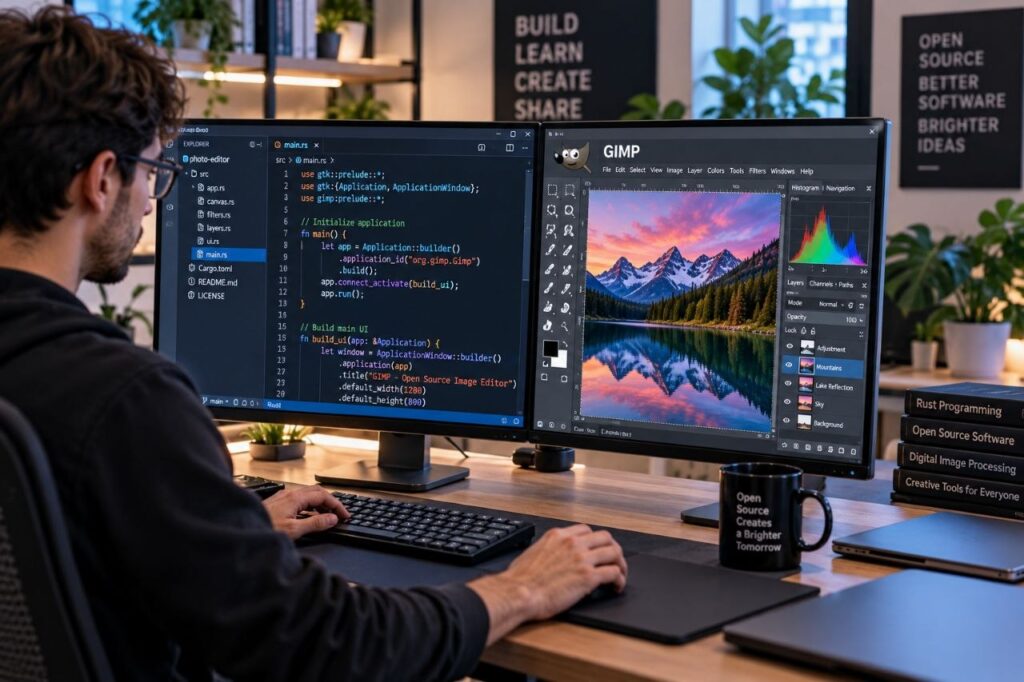
A software developer from Atlanta has sparked widespread discussion across the tech community after releasing a suite of open source applications designed to replicate Adobe’s flagship creative tools. Developer Brandon Thomas announced the project, known as ArtCraft, following frustration with subscription models and cancellation fees associated with commercial software, notably referencing Adobe’s prior legal settlements with the U.S. government.
Using Anthropic’s Claude Opus 5.5 and the Rust programming language, Thomas built seven distinct applications intended to mimic popular tools such as Photoshop, Illustrator, Premiere, After Effects, InDesign, Lightroom, and Acrobat Pro. Equivalent open source alternatives introduced under the project include tools like PhotoCraft, VectorCraft, FilmCraft, and LightCraft. The source code is freely distributed under MIT and Apache 2.0 licenses.
How the AI-Assisted Development Works
The development approach highlights a notable escalation in AI-assisted programming and reverse engineering. Thomas utilized Claude Opus 5.5 to accelerate the creation of clean-room replacements—a legal term describing functional software replication without directly copying proprietary source code. By writing the core applications in Rust, a systems programming language celebrated for performance and memory safety, the software is designed to run natively across Windows, Linux, and macOS. Additionally, WebAssembly versions have been made available for browser-based usage.
Despite the ambitious scope of the project, tech observers and users on platforms like Hacker News and Reddit have noted that the software currently exists in a very rough, super-early alpha state. While the applications successfully open test files, feature layers, and mimic familiar user interfaces, they lack much of the deep polish, stability, and advanced feature sets found in mature commercial suites.
Community Reactions and Future Outlook
The release has reignited broader conversations regarding the changing landscape of software engineering, with Thomas boldly declaring on social media that traditional software development paradigms are shifting dramatically. Observers have pointed out both the impressive speed of AI-driven code generation and the substantial hurdles required to match decades of refinement in commercial creative software.
Thomas has emphasized that community contributions and collaborative coding will be essential to iron out existing bugs, fill in missing capabilities, and improve overall usability. For digital artists and designers seeking free alternatives to subscription-based creative suites, the project represents an intriguing early experiment in what rapid, AI-powered reverse engineering can achieve.