
Quantum Spins Move Centimeter-Scale Levitated Diamond in Lab
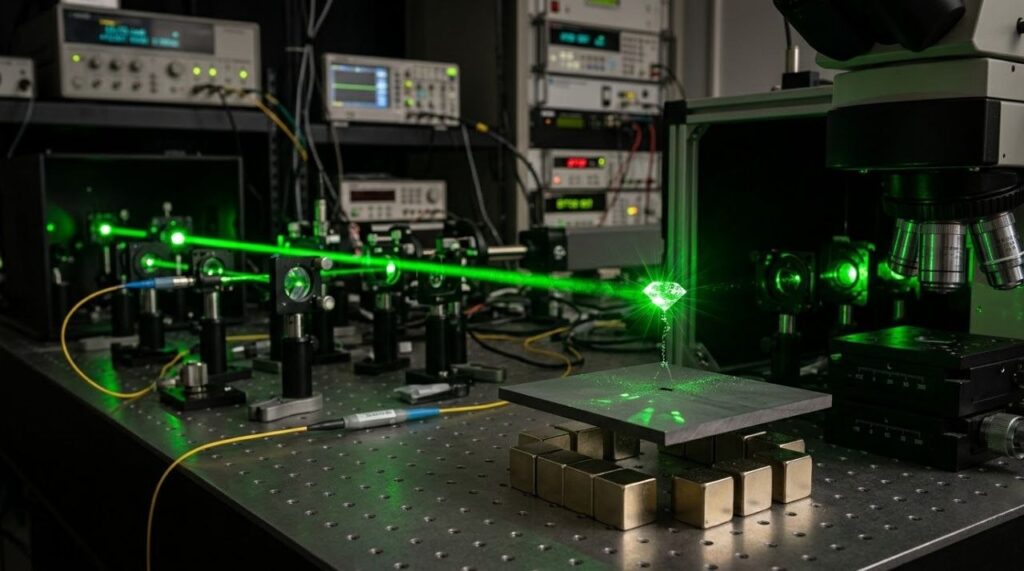
In a groundbreaking physics experiment, researchers have successfully moved a centimeter-scale, levitated object using nothing more than the quantum spin of electrons. Conducted at the Okinawa Institute of Science and Technology (OIST) in Japan, the experiment marks the first time that a quantum effect has been observed directly manipulating a macroscopic object subject to gravity.
The breakthrough bridges a critical gap in physics, offering a new method to study the hazy boundary where quantum mechanics intersects with classical physics. Details of the achievement were published in the journal Science Advances.
How the Levitated Diamond Experiment Worked
To achieve this macroscopic movement, the OIST research team constructed a specialized mechanical oscillator totaling 128 milligrams in mass. The assembly featured a diamond crystal containing billions of microscopic defects known as nitrogen-vacancy (NV) centers. These centers trap unpaired electrons, which function as controllable quantum magnets driven by their inherent quantum spin force.
The diamond itself was suspended above a magnet and connected via a carbon rod to a diamagnetically levitated graphite plate equipped with a small mirror. To translate quantum states into physical motion, the researchers periodically illuminated the diamond with a green laser. This light polarized the nitrogen-vacancy centers into a predefined spin state, generating tiny magnetic fluctuations that pushed the diamond downward.
An extremely sensitive laser interferometer bouncing light off the mirror tracked the resulting displacement with picometer precision. According to the research team, the setup observed oscillations of about 100 nanometers in air and up to roughly 1.5 micrometers in a vacuum.
Significance and Future Implications
Scientists involved in the project emphasize that the experiment demonstrates a significant classical response generated from a minute quantum effect. The total mass of the moving oscillator was between 100 million and 1 billion times larger than the objects typically handled in previous state-of-the-art spin-mechanics experiments.
While the setup demonstrates macroscopic spin-mechanical coupling rather than quantum superposition, researchers believe it lays the groundwork for advanced technological applications. OIST Professor Jason Twamley noted that the achievement shifts the focus toward refining experimental conditions to eventually achieve quantum superposition within the regime of Einstein’s general relativity.
Additionally, the development paves the way for a new class of ultra-precise sensors, pushing measurement capabilities from the nanometer scale up to the centimeter scale.