
Quantum Spins Move Levitating Diamond in Physics Breakthrough
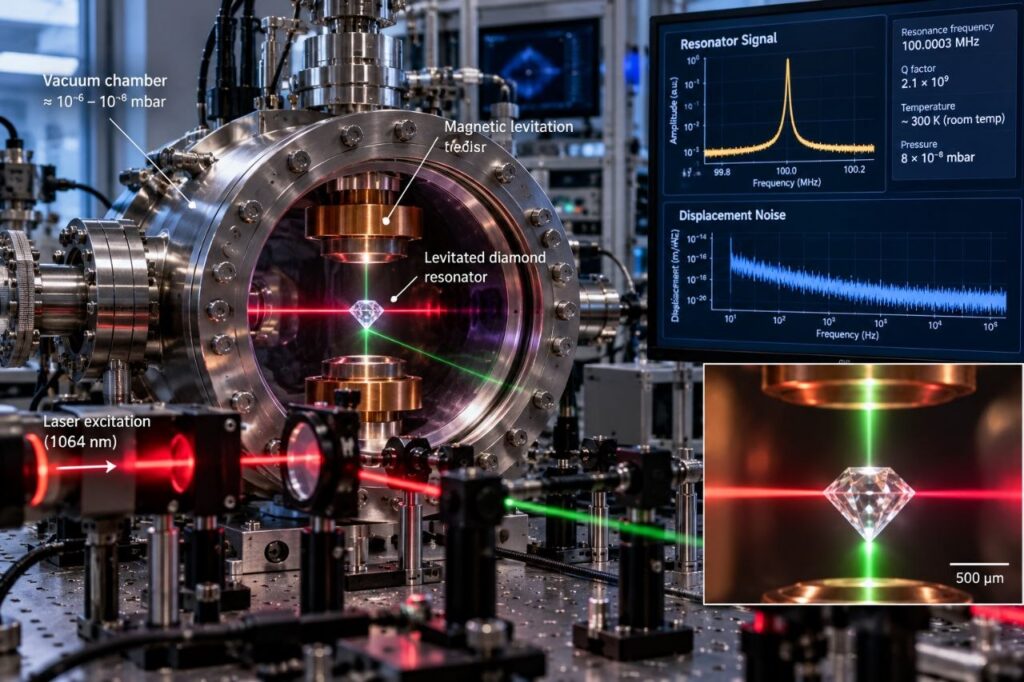
In a groundbreaking physics experiment, researchers have successfully used quantum electron spins to move a massive, centimeter-scale object in a laboratory setting. Conducted at the Okinawa Institute of Science and Technology (OIST) in Japan and published in the journal Science Advances, the achievement marks the first time a direct quantum effect has been observed manipulating an object subject to gravity at a macroscopic scale.
Bridging Quantum Mechanics and Classical Physics
For decades, physicists have struggled to observe delicate quantum phenomena in larger objects because macroscopic items are typically governed by classical physics and disrupted by environmental thermal noise and gravity. While previous state-of-the-art spin-mechanics experiments typically dealt with objects orders of magnitude smaller, the OIST research team took a different approach by combining large-scale diamagnetic levitation with microscopic control.
The experimental setup featured a diamagnetically levitated assembly with a total moving mass of 128 milligrams. The system included a graphite plate fitted with a mirror, connected via a carbon rod to a diamond hanging above a magnet. The diamond contained billions of nitrogen-vacancy centers—atomic defects that trap unpaired electrons acting as tiny, controllable quantum magnets. By using laser-driven spin polarization to manipulate these electron spins, the team generated magnetic forces capable of producing measurable mechanical motion in the levitating structure.
Measuring Macroscopic Spin-Mechanical Coupling
Using advanced interferometry, the researchers detected physical displacement of the levitated diamond assembly. During testing, oscillations of approximately 100 nanometers were observed in ambient air, while oscillations increased up to about 1.5 micrometers in a vacuum. This macroscopic spin–mechanical coupling demonstrates that quantum-level forces can effectively translate into movement for objects hundreds of millions to billions of times larger than those used in standard quantum experiments.
The successful demonstration opens new avenues for studying the boundary between quantum mechanics and classical physics. Furthermore, researchers believe the breakthrough could pave the way toward advanced quantum sensing technologies and novel methods for investigating the subtle interactions between quantum systems and gravity.