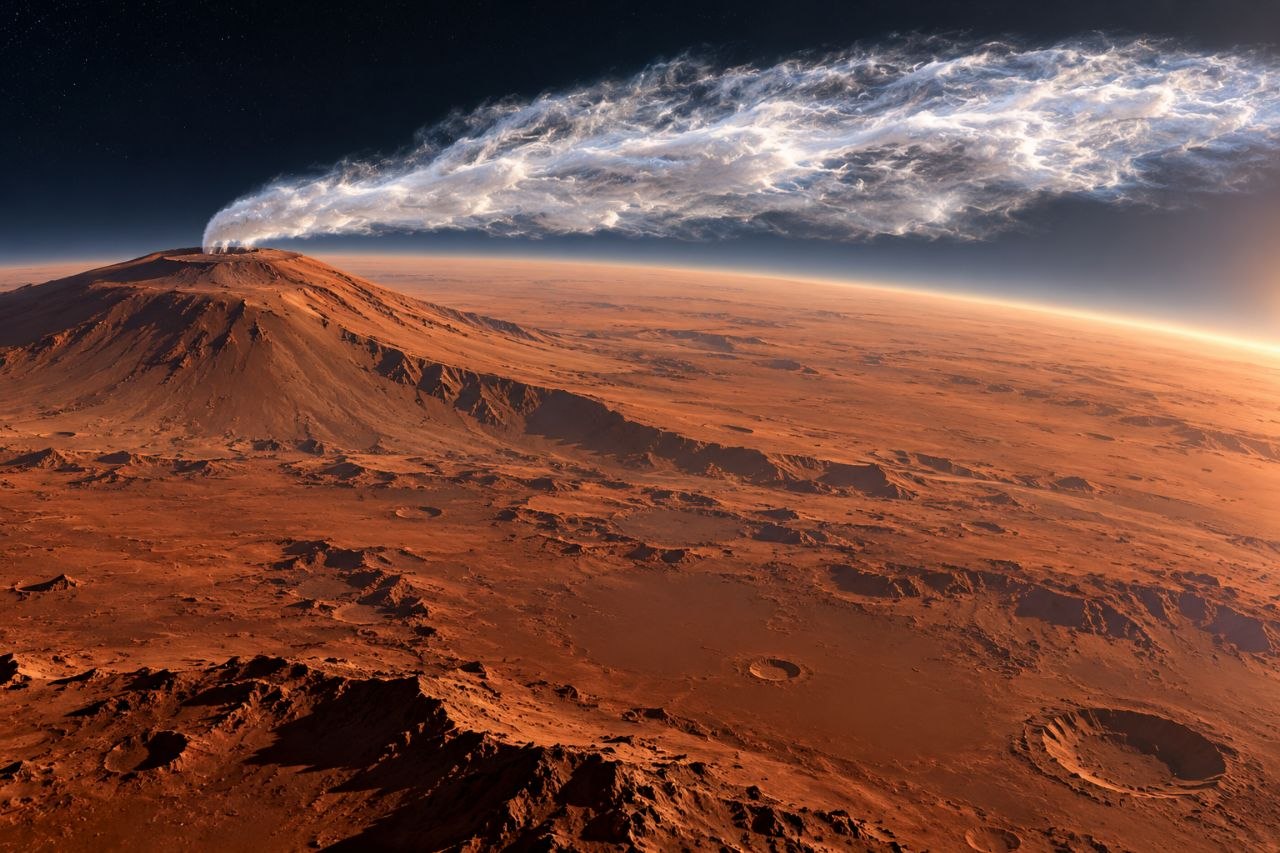
Scientists have finally solved the mystery of a colossal, recurring cloud on the Red Planet that stretches over 1,000 miles long and materializes every single morning. Published in Nature Geoscience, a new study reveals that the bizarre meteorological phenomenon is driven by an unusual process of ice physics that has never before been observed in any planetary atmosphere.
The floating mass, officially known as the Arsia Mons Elongated Cloud (AMEC), was first spotted in 2018 by the European Space Agency’s Mars Express orbiter. Spanning up to 1,100 miles (1,800 kilometers)—roughly one-twelfth of Mars’ circumference—the water vapor cloud emerges nearly every morning during the southern hemisphere’s spring and summer seasons. It forms downwind of Arsia Mons, a massive extinct volcano standing 12 miles (20 kilometers) tall in the Tharsis region just south of the Martian equator, before rapidly evaporating within a few hours.
Cracking the Code With Exotic Physics
For years, planetary scientists suspected the feature was an orographic cloud, which forms when wind flows over elevated terrain like a mountain or volcano. However, early computer simulations consistently failed to replicate what spacecraft cameras captured. No modeling technique could match the cloud’s rapid growth and unique lifecycle until researchers incorporated theoretical principles once thought too exotic to occur naturally in an atmosphere.
“To create the Arsia Mons Elongated Cloud in our modelling, we found that we needed to include some exotic physics… physics that, while included in textbooks, is treated as theoretical and usually thought not to happen in nature,” said Jorge Hernández-Bernal of LMD/CNRS/Sorbonne Université in Paris, the study’s lead author.
When researchers factored this theoretical framework into their simulations, the massive cloud finally emerged just as observed by the Mars Express orbiter.
Homogeneous Nucleation in Action
The breakthrough centers on a mechanism called homogeneous nucleation. Typically, clouds form when atmospheric water vapor condenses or freezes onto microscopic particles suspended in the air, such as dust or sea salt. On Mars, a dusty planet, this particle-assisted condensation is standard.
However, the new study shows that the AMEC operates entirely differently. As powerful winds race up the slopes of the 12-mile-high volcano, they trigger an intense atmospheric wave that violently shoots moist air upward within minutes. Calculations indicate that the temperature of this rising air drops by roughly 30 degrees Celsius (54 degrees Fahrenheit) in just 10 minutes, causing a massive spike in relative humidity.
Under these extreme conditions, water vapor bypasses the traditional dusting-agent step entirely, freezing directly into ice crystals out of thin air. Researchers compare the phenomenon to droplets spontaneously condensing in the middle of a room rather than on a cold windowpane.
This discovery marks the first time homogeneous nucleation has been documented in action within a planetary atmosphere, offering fresh insight into extreme meteorological processes on neighboring worlds.