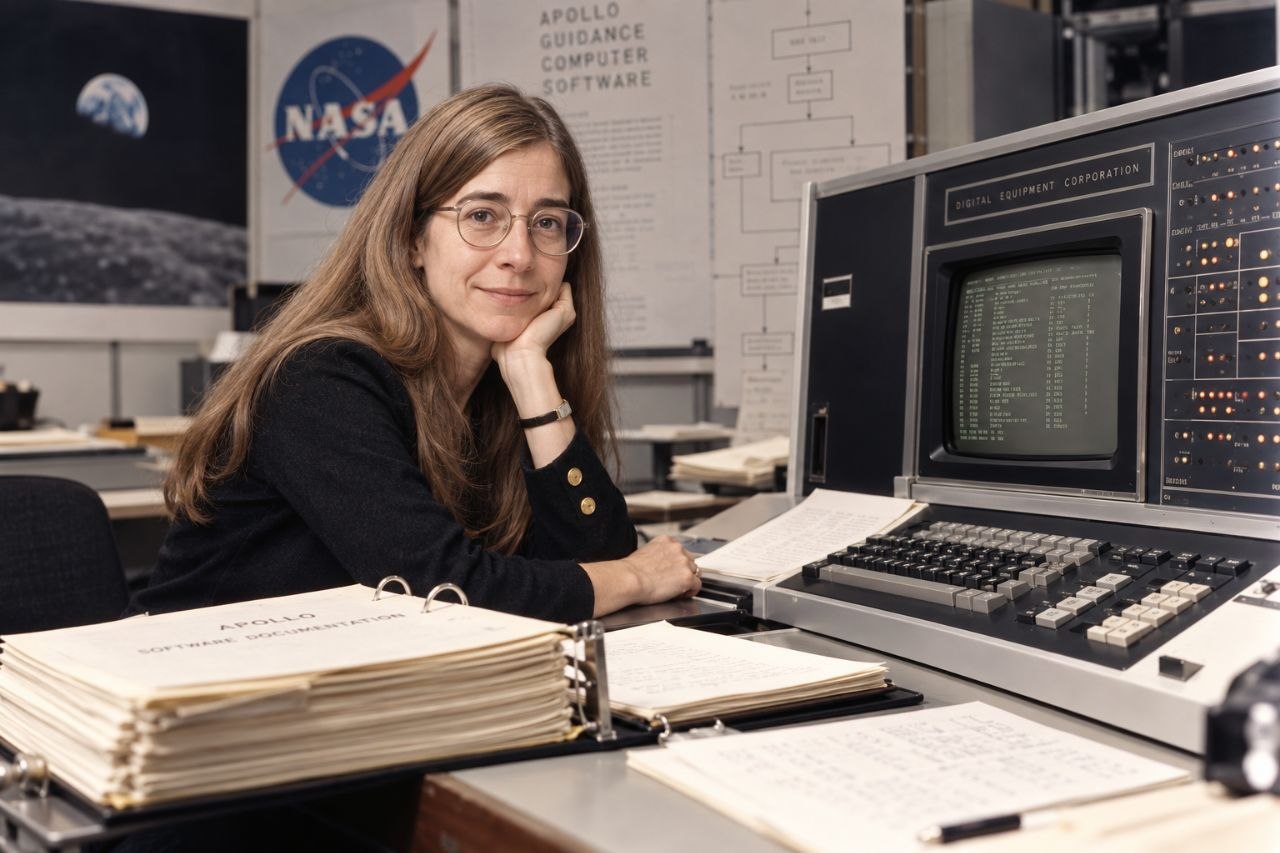
Margaret Hamilton, a groundbreaking computer scientist and pioneering Margaret Hamilton software engineer who led the team that created the onboard flight software for NASA’s moon-bound Apollo program, has died at the age of 90.
The Massachusetts Institute of Technology (MIT), her former employer, confirmed her death, stating she passed away on September 30 in a hospital, as reported by her daughter, Lauren. The specific cause of her death was not disclosed.
A Pioneer of Software Engineering
Born on August 17, 1936, in Indiana, Hamilton grew up in Michigan before moving to Cambridge, Massachusetts, in her early twenties. She initially began working as a young mathematician at MIT in the early 1960s to support her husband through law school by working in a computer lab. When she learned that MIT was designing in-flight computers for the upcoming lunar missions, she eagerly joined the team.
Hamilton worked at MIT from 1959 until the mid-1970s, managing the Software Engineering Division. During an era when computer science was in its infancy and the term “software engineering” was not yet mainstream, Hamilton helped define the discipline. She not only developed advanced code herself but also led a team in utilizing nascent technology to build one of the most complex computing systems humanity had ever achieved.
“To say Margaret Hamilton was a pioneer — to say she was ahead of her time — would be a dramatic understatement,” said Olivier de Weck, the Apollo Program Professor and interim head of the MIT Department of Aeronautics and Astronautics, in a statement. “She was a software engineer at a time when that field was in its infancy.”
The Legacy of the Apollo Missions
Hamilton’s code played a critical role in the success of the Apollo missions, ensuring that spacecraft could reliably navigate to the moon and back. Teasel Muir-Harmony, curator of the Apollo Collection at the Smithsonian National Air and Space Museum, noted Hamilton’s exceptional foresight regarding how humans would interact with computers and her dedication to creating reliable systems capable of functioning in high-risk, life-and-death environments.
During her time at the lab, Hamilton often brought her young daughter, Lauren, with her, a habit that occasionally led to lighthearted laboratory anecdotes, such as an infamous “Lauren error” when her daughter interacted with the early test systems.
After leaving MIT in the mid-1970s, Hamilton applied her extensive expertise to the private sector, founding her own software businesses, including Hamilton Technologies, which remains based in Massachusetts.
Tributes poured in from academic institutions and space history organizations following the announcement of her death by MIT. Earlham College released a statement honoring her legacy, noting that her pioneering spirit and remarkable achievements will continue to inspire generations.