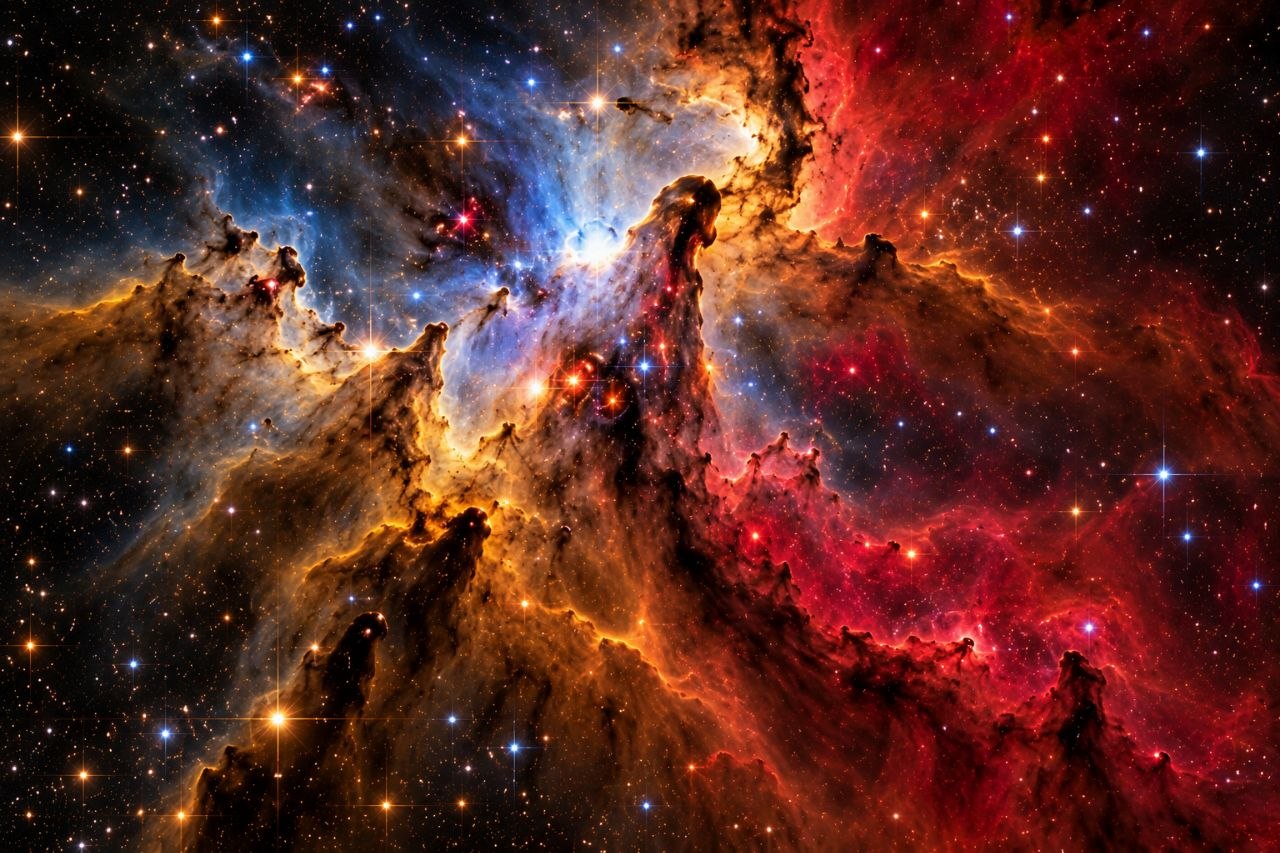
A stunning new image captured by the James Webb Space Telescope has unveiled a vibrant stellar nursery, offering astronomers an unprecedented look at a region NASA describes as a cauldron of cosmic creation. The observations focus on NGC 7129, a cosmic cloud situated roughly 3,300 light-years away from Earth.
Peer Through Cosmic Dust With Infrared Vision
Because stars spend their earliest developmental stages heavily shrouded in dense clouds of dust and gas, spotting nascent protostars has historically presented a major challenge for astronomers. However, utilizing the advanced near- and mid-infrared capabilities of the James Webb Space Telescope, researchers successfully peered directly through the obscuring dust.
The resulting high-resolution imagery highlights numerous stars and protostars at various stages of their life cycles. According to data shared by space agencies, the intricate visual details display hot, atomic hydrogen gas illuminated in striking golden hues, while cooler, molecular hydrogen gas shocked by powerful stellar jets from embedded protostars appears in vivid red.
Inside the NGC 7129 Stellar Nursery
The European Space Agency noted the intense commotion generated by stellar jets throughout the nebula. Although the cluster of stars was born from the exact same giant molecular cloud, they formed at different points in time, resulting in diverse ages across the stellar population.
Among the most influential bodies in the region is LkHα 234, a highly luminous central pre-main-sequence star estimated to weigh between five and eight times the mass of our Sun. The dynamic interplay between these massive growing stars, glowing gases, and swirling dust continues to provide researchers with critical insights into how stars first ignite and evolve within our galaxy.