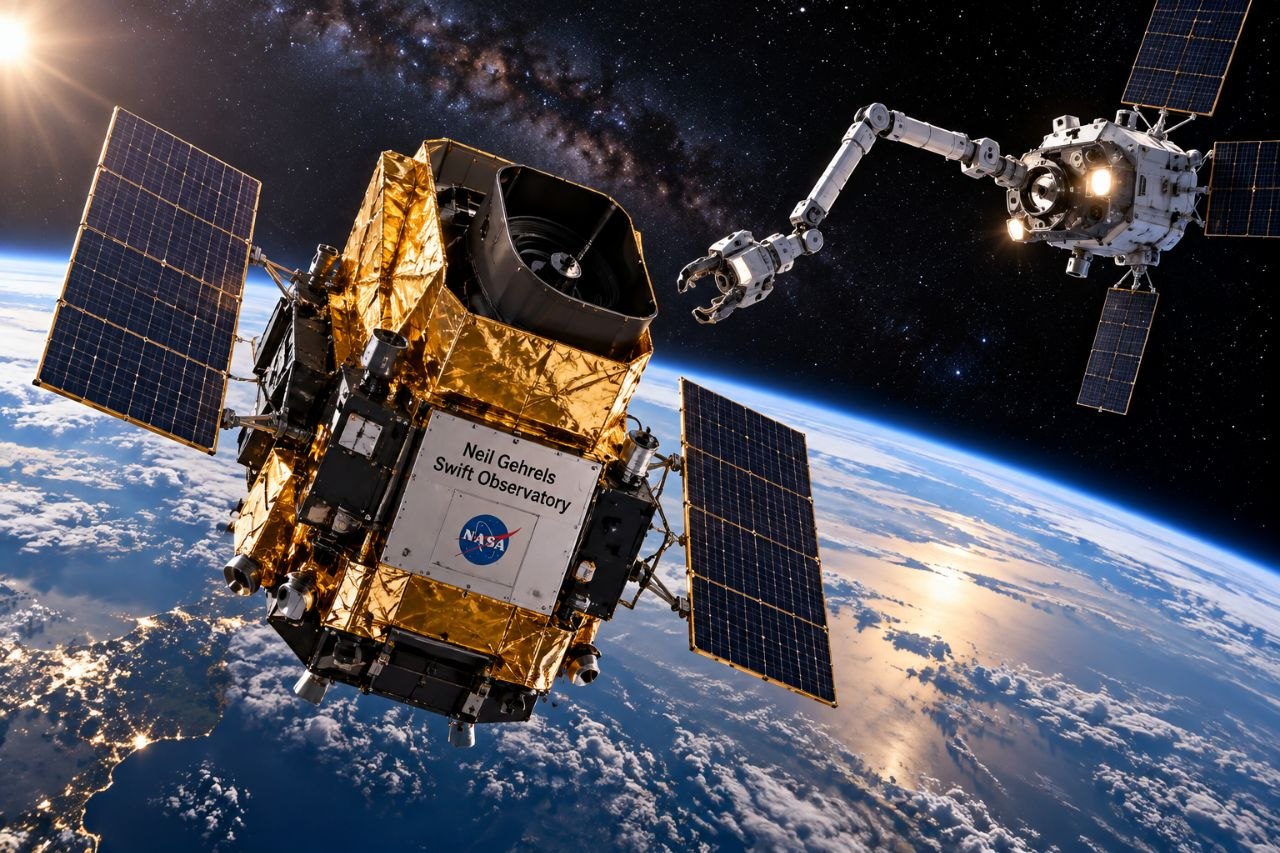
A high-stakes, unprecedented mission to save a legendary space observatory has ended in failure, leaving the spacecraft destined for an uncontrolled re-entry into Earth’s atmosphere later this year. NASA and Arizona-based startup Katalyst Space Technologies announced that a $30 million rescue attempt targeting the Neil Gehrels Swift Observatory was called off after engineers lost control of the rescue spacecraft.
Launched nearly 22 years ago, the Swift space telescope has spent its operational life tracking some of the most powerful and violent events in the universe, including gamma-ray bursts and exploding stars. However, as its orbit decayed, NASA awarded a $30 million contract to Flagstaff-based Katalyst Space Technologies to attempt an orbital rescue. The daring mission relied on a rapidly developed satellite named LINK, which was built and launched in just nine months.
Failed Spacecraft Control Dooms Observatory
The mission hit a critical roadblock when control issues emerged with the LINK spacecraft. Because engineers could not reliably manage the rescue vehicle, Katalyst confirmed that LINK would not attempt to grapple the Swift observatory and boost it to a safer, higher orbit.
NASA Administrator Jared Isaacman addressed the outcome, stating that while it was not the result teams worked toward, the ambitious endeavor was still worth attempting. Without a successful orbital boost, the Swift telescope will soon be forced to cease its scientific observations as it rapidly loses altitude. It is expected to plunge through Earth’s atmosphere and disintegrate later this year.
Lessons Learned for Future Space Operations
Although the primary rescue objective failed, both NASA and Katalyst emphasized that the mission was not a total loss. As a consolation prize and technology demonstrator, Katalyst will continue to operate the LINK spacecraft in close proximity to the doomed telescope.
Space industry experts noted that the rapid development and deployment of the LINK satellite provided valuable engineering data and operational lessons. These insights are expected to inform and aid future robotic space maintenance, satellite servicing, and debris mitigation operations as commercial and government agencies look for ways to manage aging orbital hardware.