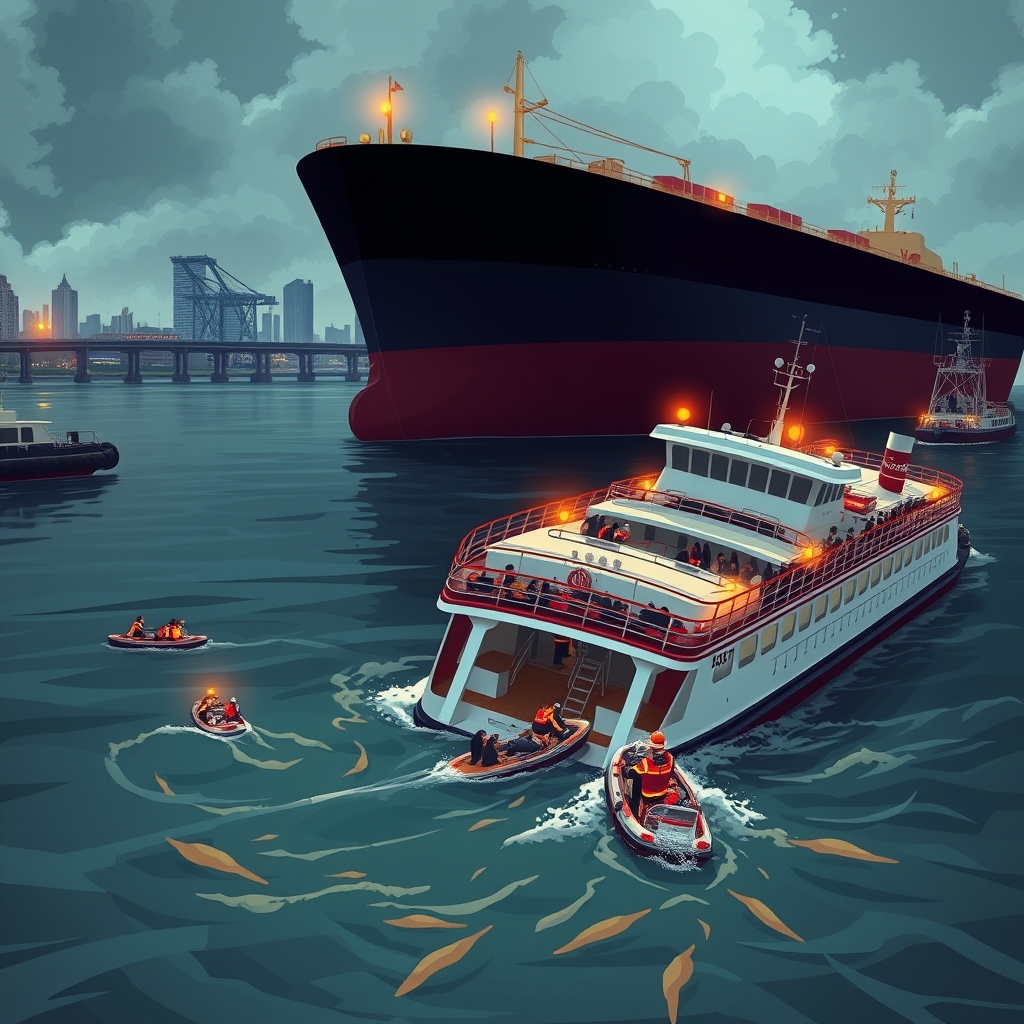
At about 12:30 p.m. on Friday, Nov. 13, 2026, an oil tanker identified as the Atlantic Asphalt struck the American Cruise Lines riverboat American Heritage while the vessel was docked on the Mississippi River outside 1350 Port of New Orleans Place. The impact caused the cruise ship to list and partially capsize, prompting a multi‑agency rescue operation that left more than 120 passengers and crew evacuated and several people in the water.
Collision details
Port of New Orleans officials confirmed that the Atlantic Asphalt tanker, a bulk carrier transporting asphalt, collided with the American Heritage as the cruise ship was preparing to begin passenger disembarkation after a two‑hour dock stop. The riverboat, which had approximately 129 passengers and an undisclosed number of crew members on board, was moored near the French Quarter when the tanker’s bow made contact with the cruise ship’s starboard side.
Initial reports from American Cruise Lines stated that the company was in “close coordination with the U.S. Coast Guard and local authorities.” The company’s spokesperson emphasized that guests and crew were evacuated safely, though the exact number of injuries remained unknown at the time of reporting.
Rescue and emergency response
Emergency responders from the City of New Orleans, the U.S. Coast Guard, the Louisiana State Police, and local fire departments converged on the scene within minutes. Firefighters assisted with water rescues, pulling passengers from the river and transferring them to a nearby tugboat for medical evaluation. Early updates indicated that about 12 people were in the water, while the majority were evacuated onto the dock or rescued by the tug.
WDSU, the local television station, reported that the rescue effort remained ongoing as of 1:42 p.m. CST, with officials continuing to account for all passengers and crew. NBC News echoed the same figures, noting that the vessel had been “t‑boned” while docked and that the conditions of those aboard were still being assessed.
Port officials posted live updates on social media, confirming that the rescue operation was proceeding and that the Mississippi River’s flow had not been significantly disrupted. No immediate environmental spill was reported, but the presence of an oil‑laden tanker prompted precautionary monitoring for potential contamination.
Investigation and next steps
The cause of the collision is under investigation. Both the U.S. Coast Guard and the National Transportation Safety Board (NTSB) have dispatched teams to gather evidence, interview crew members, and examine vessel logs. Early speculation about mechanical failure, human error, or navigational miscommunication has not been substantiated.
American Cruise Lines released a statement affirming that they are cooperating fully with authorities and that passenger safety remains the top priority. The company also indicated that it would provide support to affected guests, including medical assistance and rebooking options.
Local officials emphasized that the incident, while serious, did not result in a large‑scale evacuation of the surrounding area. Traffic on nearby streets was briefly rerouted, and the Port of New Orleans issued a notice that river traffic would be monitored closely for the remainder of the day.
As the investigation unfolds, authorities will assess whether any regulatory changes are needed for river traffic management in the busy New Orleans harbor. The incident highlights the inherent risks of operating large commercial vessels in close proximity to passenger ships on a heavily trafficked inland waterway.