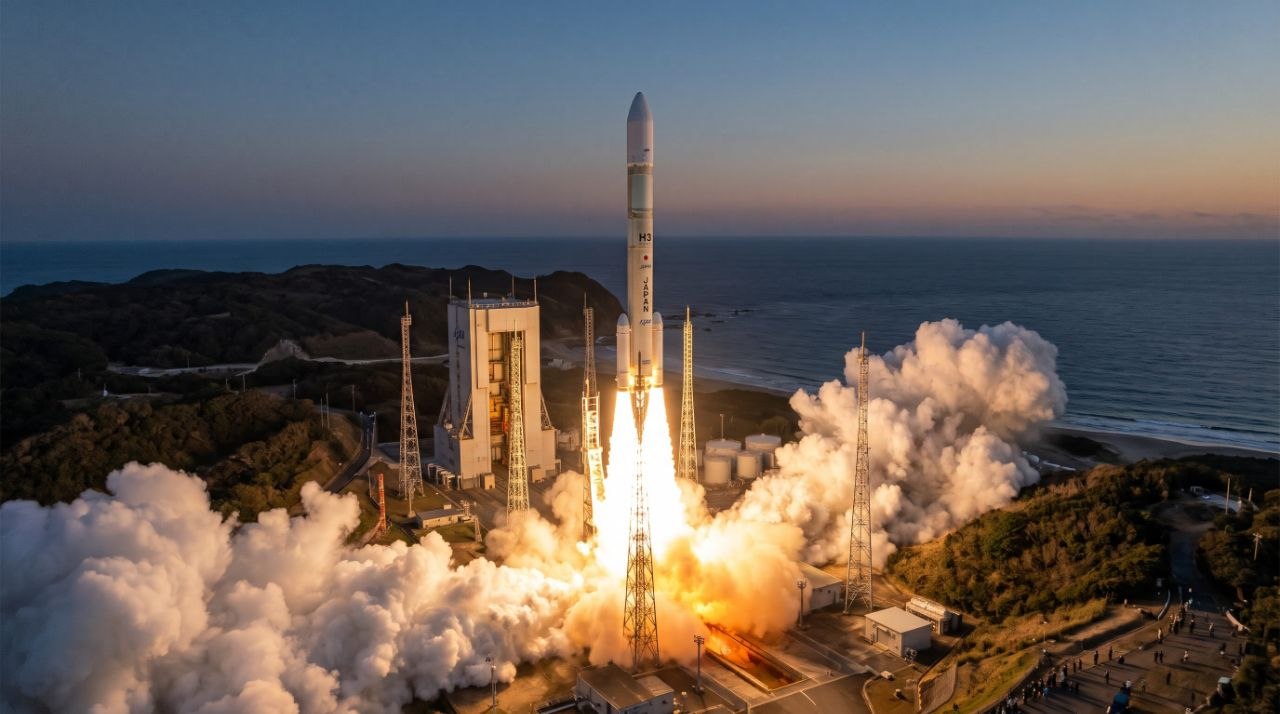
Japan has officially initiated a groundbreaking interplanetary journey aimed at unlocking the enduring mysteries of the Red Planet. The Japan Aerospace Exploration Agency (JAXA) successfully launched its Martian Moons eXploration (MMX) spacecraft toward Mars, where it intends to achieve a historic global first: landing on and returning surface and subsurface samples from the Martian moon Phobos back to Earth.
The 5-ton spacecraft lifted off aboard an H3 rocket from Pad-2 at the Yoshinobu Launch Complex at the Tanegashima Space Center in southwestern Japan. Liftoff occurred at 4:41 a.m. local time on Tuesday, corresponding to 3:41 p.m. EDT on Monday.
The Journey to Phobos and Deimos
The $578 million MMX mission is scheduled to reach the Martian system by August 2027. Once it arrives, the spacecraft will spend approximately three years orbiting Mars and studying both of its irregularly shaped moons, Phobos and Deimos.
Phobos, the larger of the two Martian moons, measures roughly 17 miles by 14 miles by 11 miles and orbits the Red Planet three times a day. Following an extensive mapping campaign to evaluate landing sites, MMX will perform two separate touchdowns on the moon. The spacecraft will collect at least 10 grams of material from both the surface and subsurface using a specialized sampling mechanism.
In addition to the main spacecraft’s touchdowns, the mission features a microwave oven-sized rover named Idefix, developed jointly by France and Germany. The autonomous rover will deploy onto Phobos, navigating the moon’s extraordinarily low gravity.
After completing its operations on Phobos, MMX will conduct several flybys of Mars’ smaller moon, Deimos—which spans a mere 8 miles in diameter—to gather additional scientific data without attempting a landing.
Answering Decades-Old Solar System Questions
Scientists hope that analyzing the returned samples on Earth will resolve a long-standing debate regarding the origins of Mars’ moons. Researchers remain divided over whether Phobos and Deimos are remnants of a massive ancient collision between Mars and another celestial body, or if they are captured asteroids pulled into orbit by the planet’s gravitational field.
Furthermore, researchers anticipate that the samples may contain ejected fragments of Mars itself, effectively providing a two-for-one scientific return that could illuminate early planetary evolution and solar system formation.
After completing its observations and sample collection, the MMX return module will depart the Martian system and is scheduled to drop its sample capsule back down to Earth, landing in Australia in 2031.