October 16, 2026 | AI & Technology
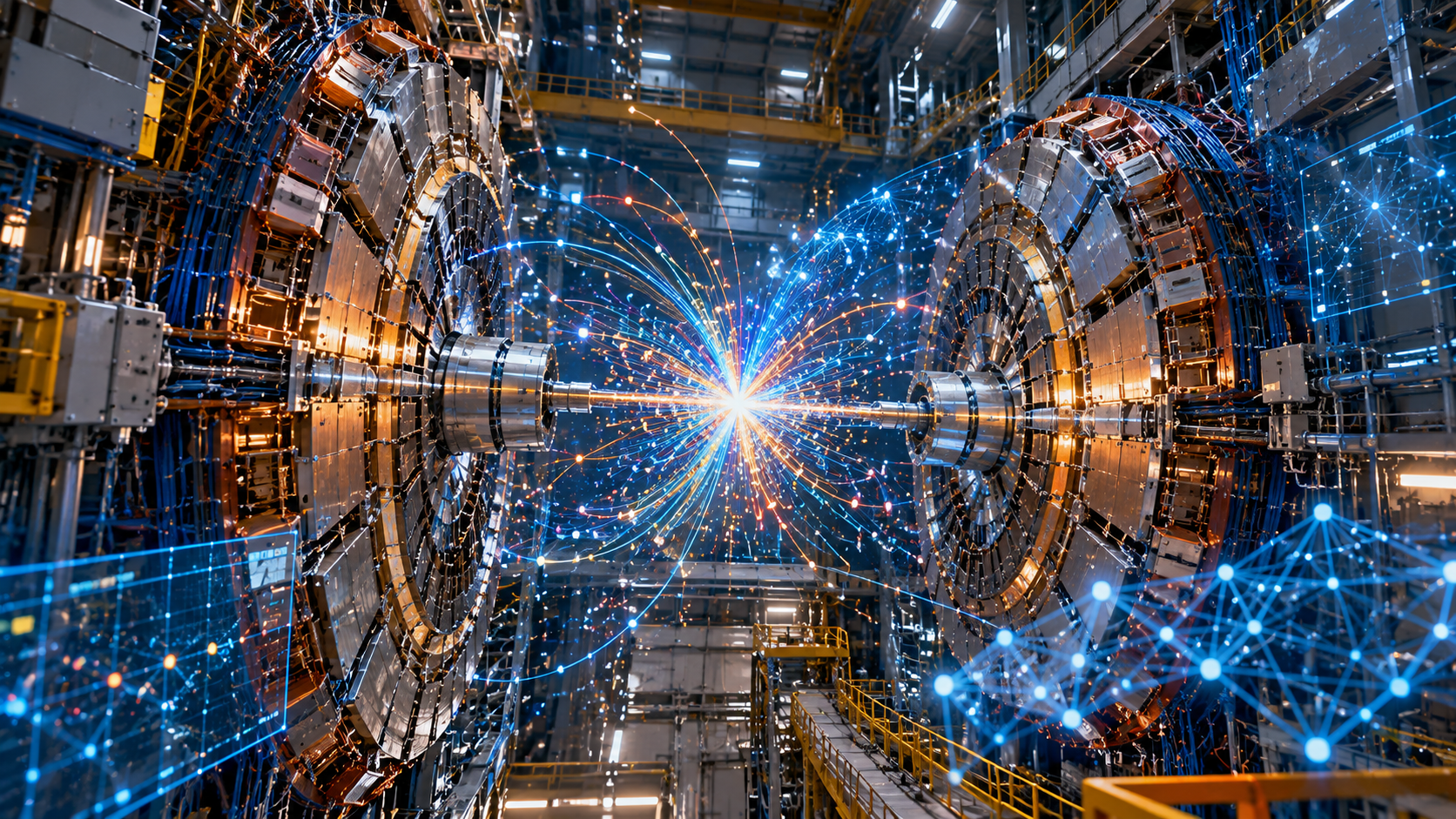
The CERN Mistral AI partnership marks a new step in applying artificial intelligence to particle physics. Announced on October 15, 2026, the collaboration aims to develop a physics foundation model capable of analyzing complex particle collision data from the Large Hadron Collider (LHC).
Announced on October 15, the collaboration aims to create a Large Physics Model capable of analyzing the enormous quantities of experimental information generated by particle collisions at the Large Hadron Collider (LHC).
The initiative represents an effort to extend the capabilities of foundation models beyond conventional applications such as text generation and image recognition into highly specialized scientific research.
However, the partnership is currently a research initiative rather than a completed AI system, and neither organization has announced a development timetable or budget.
What Is CERN’s Large Physics Model?
The proposed Large Physics Model is intended to become a foundation model for collider physics, trained on billions of simulated proton-proton collisions.
Unlike a conventional language model, which learns statistical relationships from large collections of text, the physics model would learn patterns within complex particle-collision data.
At the LHC, high-energy particle collisions produce signals that sophisticated detectors record. Scientists must then reconstruct these signals to determine which particles were produced and how they behaved.
The process involves multiple stages of computation, including identifying particle trajectories, estimating energies and interpreting detector measurements.
CERN and Mistral hope a shared pretrained model could support several of these tasks rather than relying exclusively on separate algorithms developed for individual stages.
The organizations also intend to investigate whether such a system could help identify unusual signals that deserve closer scientific examination.
That possibility is important because unexpected patterns in experimental data can sometimes guide researchers toward previously unexplored physical phenomena.
Nevertheless, identifying an unusual signal would not by itself establish a scientific discovery. Any result would still require extensive validation and independent analysis.
Why the Large Hadron Collider Needs More Advanced AI
The Large Hadron Collider, located near Geneva on the French-Swiss border, is the world’s largest and most powerful particle accelerator.
Its experiments produce vast amounts of information as scientists investigate the fundamental structure of matter and the forces governing the universe.
According to CERN, approximately one exabyte of experimental data from the LHC has been stored to date. That is equivalent to roughly one million terabytes.
The scale of the challenge is expected to increase significantly as CERN prepares for the High-Luminosity Large Hadron Collider, an upgrade scheduled to begin operation around 2030.
CERN expects the number of particle collisions to increase by approximately ten times.
More collisions provide opportunities to investigate rare physical processes, but they also create additional demands on data processing, computing infrastructure and scientific analysis.
Advanced machine learning could help researchers process information more efficiently and identify patterns within datasets too large for conventional manual examination.
A New Direction for Artificial Intelligence in Science
Artificial intelligence is not new to particle physics.
Researchers have used machine-learning techniques for years to classify detector signals, reconstruct events and improve computational performance.
The proposed partnership differs in its ambition to develop a more general-purpose scientific foundation model that could perform several related tasks.
If successful, the approach could reduce the need to build entirely separate machine-learning systems for each stage of analysis.
It could also make it easier to transfer knowledge between scientific applications, although the practical benefits will depend on performance, reliability and computational efficiency.
CERN Chief Information Officer Enrica Porcari said the laboratory provides an environment where artificial intelligence can be developed and tested with exceptional scientific rigor.
The partnership also reflects growing European interest in applying advanced AI capabilities to fundamental research.
For Mistral, the project offers an opportunity to explore scientific applications beyond the commercial and language-focused systems commonly associated with generative AI.
Opportunities and Scientific Challenges
The potential benefits are substantial, but several important questions remain unresolved.
First, scientific models must demonstrate extremely high accuracy. An apparently small error in reconstructing experimental measurements could affect subsequent analysis.
Second, researchers must understand how a model reaches its conclusions, particularly when evaluating unusual patterns that might indicate new physics.
Third, large-scale model training requires computing resources and electricity, meaning researchers will need to assess whether any improvement in analytical performance justifies the additional cost.
Finally, AI-assisted scientific results must remain reproducible and subject to established standards of independent verification.
A powerful foundation model could become a useful scientific instrument, but it would not replace the need for physicists to test hypotheses, evaluate uncertainty and confirm experimental findings.
Could the Technology Benefit Other Sciences?
Although high-energy physics is the initial focus, CERN and Mistral have suggested that the underlying approach could eventually support other scientific fields.
Disciplines such as materials science, astronomy and complex experimental research also generate large datasets that may benefit from advanced pattern recognition.
However, applications outside collider physics remain possibilities rather than confirmed outcomes of the partnership.
The immediate objective is to establish whether a foundation-model approach can improve the processing and interpretation of particle-collision information.
What Happens Next?
The organizations have signed a statement of intent outlining their ambition to cooperate on AI for science.
The next steps will involve research, model development and evaluation against existing scientific techniques.
No public launch date, deployment schedule or financial commitment has been announced.
The collaboration is therefore best understood as a potentially important scientific research project, not as evidence that a new AI system has already transformed particle physics.
Its long-term significance will depend on whether the proposed model can demonstrate measurable improvements in accuracy, efficiency and scientific usefulness.
For CERN and Mistral, the central challenge is to turn the promise of foundation models into tools that meet the demanding standards of experimental science.
Sources
- CERN — CERN and Mistral join forces to accelerate AI for science (October 15, 2026): https://home.cern/cern-and-mistral-join-forces-to-accelerate-ai-for-science/
- Reuters — CERN and Mistral partner to build AI foundation models for physics (October 15, 2026): https://www.reuters.com/science/cern-mistral-partner-build-ai-foundation-models-physics-2026-10-15/