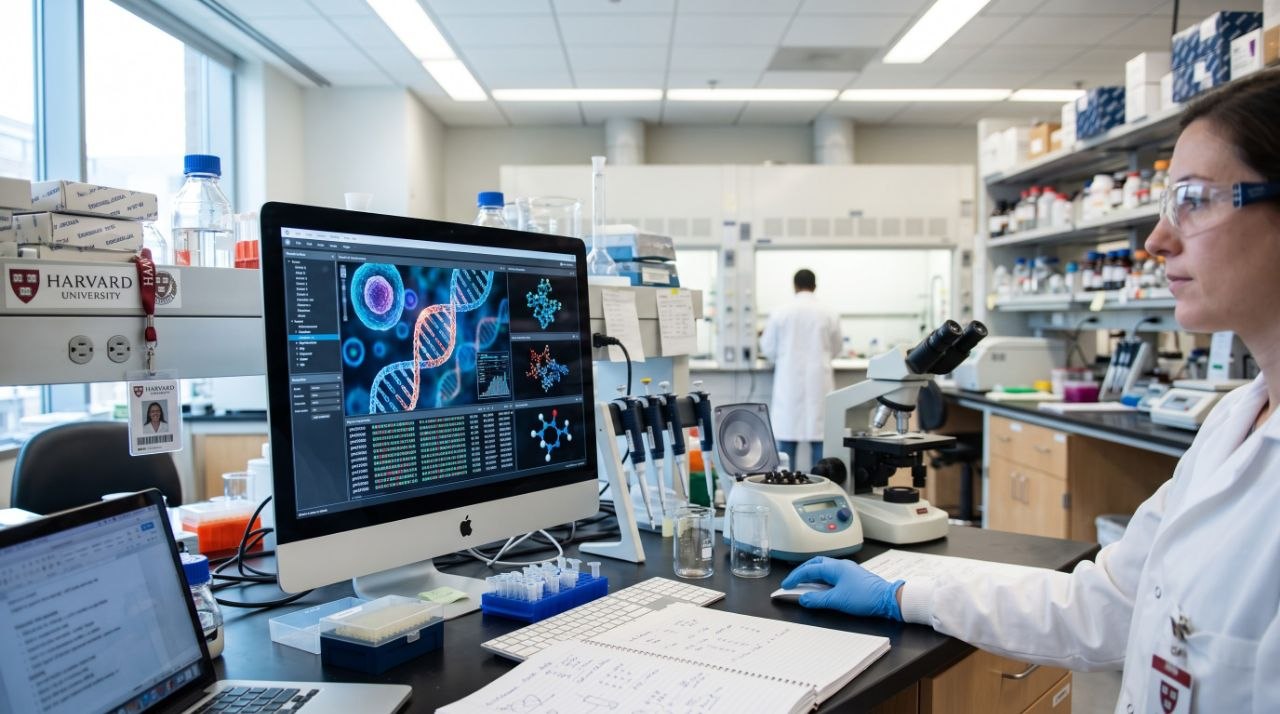
A recent scientific study led by researchers at Harvard University has identified a single protein that can shift aged cells toward a younger molecular profile and extend median lifespan in laboratory mice. Published in the journal Nature Aging, the research centers on SRSF1, an RNA-processing factor that plays a critical role in how genetic messages are handled within cells.
The research team, led by George M. Church, a professor of genetics at Harvard Medical School, alongside lead contributors including Alexandru M. Plesa and Sascha Jung, set out to look for safer alternatives to traditional cellular reprogramming methods. While techniques that revert adult cells to a stem-like state have shown promise in animal studies, concerns regarding toxicity, loss of cell identity, and potential cancer risks have driven scientists to search for more targeted approaches.
How the SRSF1 Gene Regulator Works
The investigation began with a computational foundation. The team built an interpretable transcriptomic age predictor calibrated in human fibroblasts, utilizing data from 133 donor lines spanning ages 1 to 96. This model distilled biological aging down to 292 genes whose activity tracks the passage of biological time.
Through a transcriptomic reprogramming screen, the researchers isolated the splicing factor SRSF1 as a powerful regulator of aging. When researchers applied regulated expression of SRSF1 to cultured human skin cells, it successfully shifted aged fibroblasts toward younger molecular profiles while preserving their cellular identity.
To test the effects in whole animals, the team delivered SRSF1 using a liver-tropic adeno-associated virus (AAV) administered to aged mice. According to the findings, the treated animals experienced:
- An extension of median lifespan by approximately 14%, increasing from 778 days in control groups to 886 days in a small experiment of 19 aged female mice.
- Improvements in endurance, health, and a slower progression of systemic frailty.
- Delayed onset of sustained frailty by approximately 123 days.
- Faster closure of skin wounds, achieving a partial restoration of young regenerative capacity.
Limitations and Next Steps
Despite the promising laboratory results, scientists and independent commentators emphasize that the work remains strictly preclinical. The experiments involved a small sample size of aged female mice, and the molecular effects were shown to depend heavily on timing. Brief exposure to the protein failed to produce sustained younger scores days after withdrawal, while longer induction periods left longer-term durability partially unresolved.
Researchers stress that substantial hurdles remain before any potential clinical applications can be considered. Further requirements include larger replication studies, rigorous long-term safety testing, and precise control over gene expression. Nevertheless, investigators view SRSF1 as a promising “geroprotective” target that illuminates new pathways for understanding and potentially intervening in biological aging.