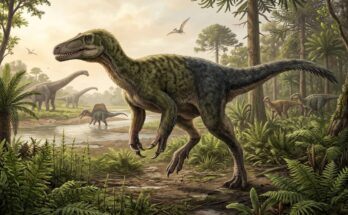
A UCL-led team of researchers has identified a new dinosaur species from a fossil that sat unexamined in a museum drawer for more than a century. The newly described predator, named Invictibellatrix amberina, is a long-clawed meat-eater roughly the size of a large tiger and represents the first known megaraptoran dinosaur ever discovered in Europe.
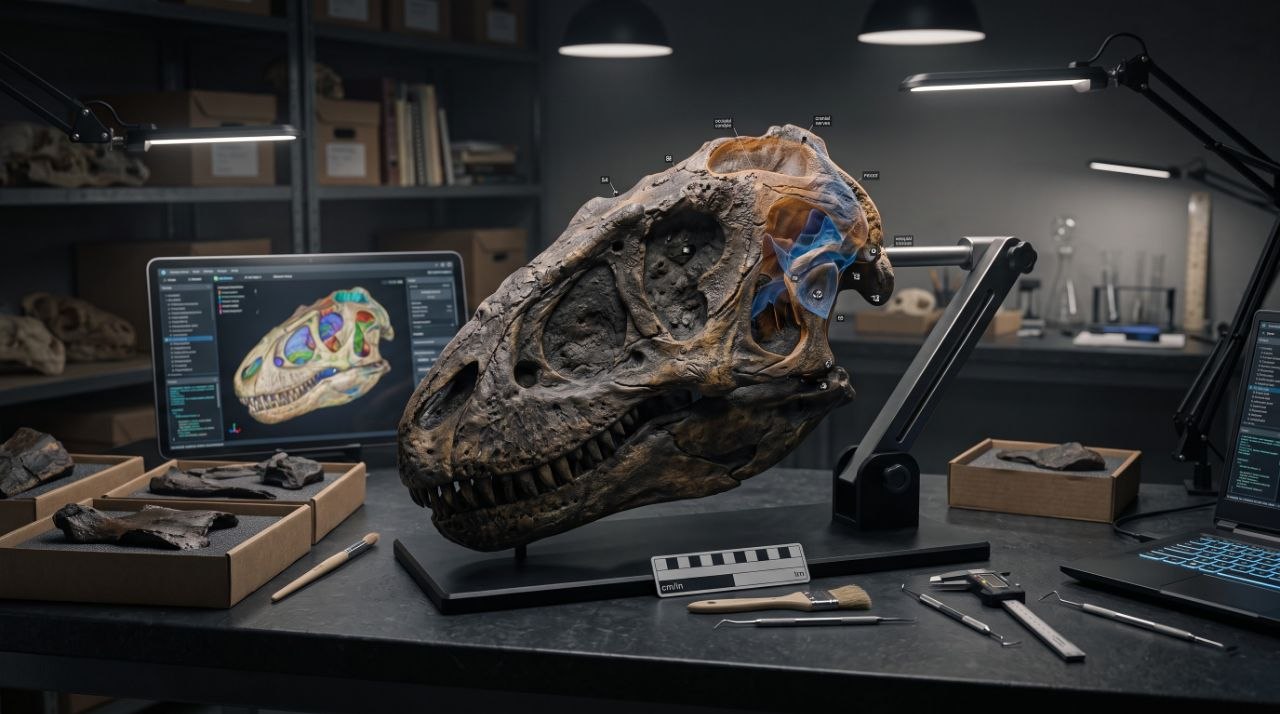
The fossilized skull fragment was originally uncovered at the foot of a cliff on the southwest coast of the Isle of Wight by amateur paleontologist Reginald Walter Tooley. It was part of a collection of more than 1,000 specimens later acquired by London’s Natural History Museum after Tooley’s death. Despite being found decades ago, the specimen remained overlooked until recent analyses revealed its true scientific significance.
Unlocking a Century-Old Mystery
The details of the discovery were published in the journal Royal Society Open Science. To investigate the fragmentary remains, scientists used advanced computed tomography (CT) scanning to generate a high-resolution 3D digital model of the skull portion and the interior braincase.
Comparative anatomy and phylogenetic analysis revealed that the creature belonged to the Megaraptora—an agile group of two-legged carnivorous theropods regarded by paleontologists as among the most mysterious large meat-eating dinosaurs due to sparse fossil records worldwide. Researchers found that the closest anatomical match was the South American megaraptoran Murusraptor, which lived approximately 80 million years ago. However, the Isle of Wight specimen dates back roughly 120 million years to the Early Cretaceous period’s Wessex Formation.
Implications for Dinosaur Evolution
The identification of Invictibellatrix amberina has major implications for understanding dinosaur biogeography and prehistoric migration routes. Scientists believe the discovery bridges a significant gap in the global distribution of megaraptorans.
Researchers suggest that megaraptorans likely evolved from Asian ancestors that dispersed into Europe roughly 130 million years ago. From Europe, these apex predators may have traveled onward to Africa, eventually spreading to South America and Australia before continental landmasses fully separated. Co-authors note that the fossil provides the first concrete evidence that megaraptorans inhabited Europe, establishing a terrestrial dispersal path toward Gondwana rather than relying strictly on southern island-hopping.
While the new find sheds light on early Cretaceous predator diversity, experts emphasize that further fossil discoveries will be needed to fully map the evolutionary history and geographic range of the enigmatic group.