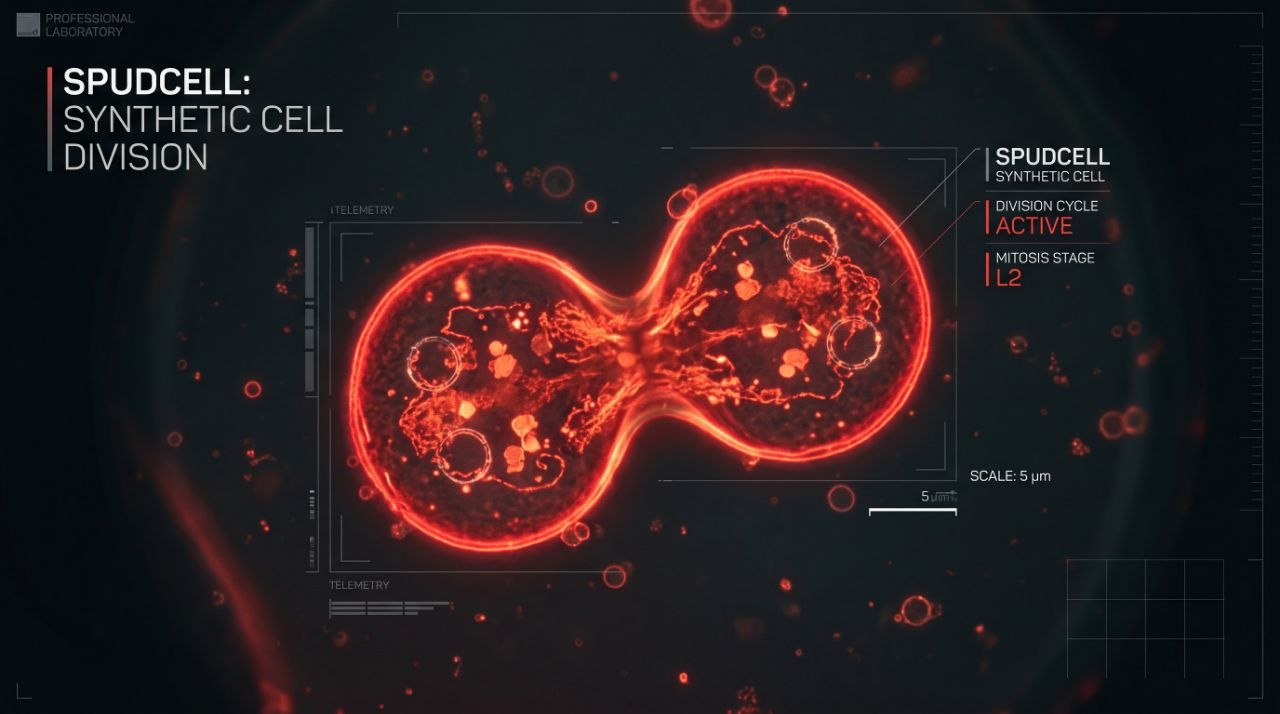
Researchers at the University of Minnesota have reached a major milestone in synthetic biology by developing an artificial cell-like system known as SpudCell. Unveiled by synthetic biologist Dr. Kate Adamala and her team, the system is assembled entirely from purified, non-living chemical components rather than modified living cells.
Unlike natural organisms, SpudCell is constructed from scratch to mimic foundational biological processes. According to researchers, the synthetic cell can absorb nutrients, grow, replicate its genetic material, and divide into new cells. In laboratory observations, the system successfully completed a full cell cycle, with researchers even noting rudimentary competition and selection across multiple generations.
Building Life From the Ground Up
The creation of SpudCell addresses decades of scientific effort aimed at building life from lifeless parts. The artificial system features a compact genome containing roughly 90,000 base pairs, making it significantly smaller than the genomes of most natural bacteria. By utilizing specialized food sources and engineered proteins, the research team enabled the cells to feed, grow, and eventually bend inward to split into new cells.
Despite these advanced capabilities, experts emphasize that SpudCell is not considered fully alive. The system still relies heavily on supplied nutrients and external molecular machinery, lacking the ability to sustain itself independently in the wild like natural organisms.
Future Applications and Safety Discussions
As the scientific community explores the implications of these developments, researchers, ethicists, and government representatives have begun discussing how to safely harness synthetic cells. Discussions held at institutions such as the Science History Institute in Philadelphia have focused on steering synthetic biology toward beneficial applications while managing potential misuse.
Scientists hope that further refinement of systems like SpudCell could eventually lead to customized biological tools for advanced medicine, targeted drug production, and sustainable manufacturing. By creating biological systems that can be fully understood and controlled, researchers believe synthetic biology will open new avenues for scientific innovation.