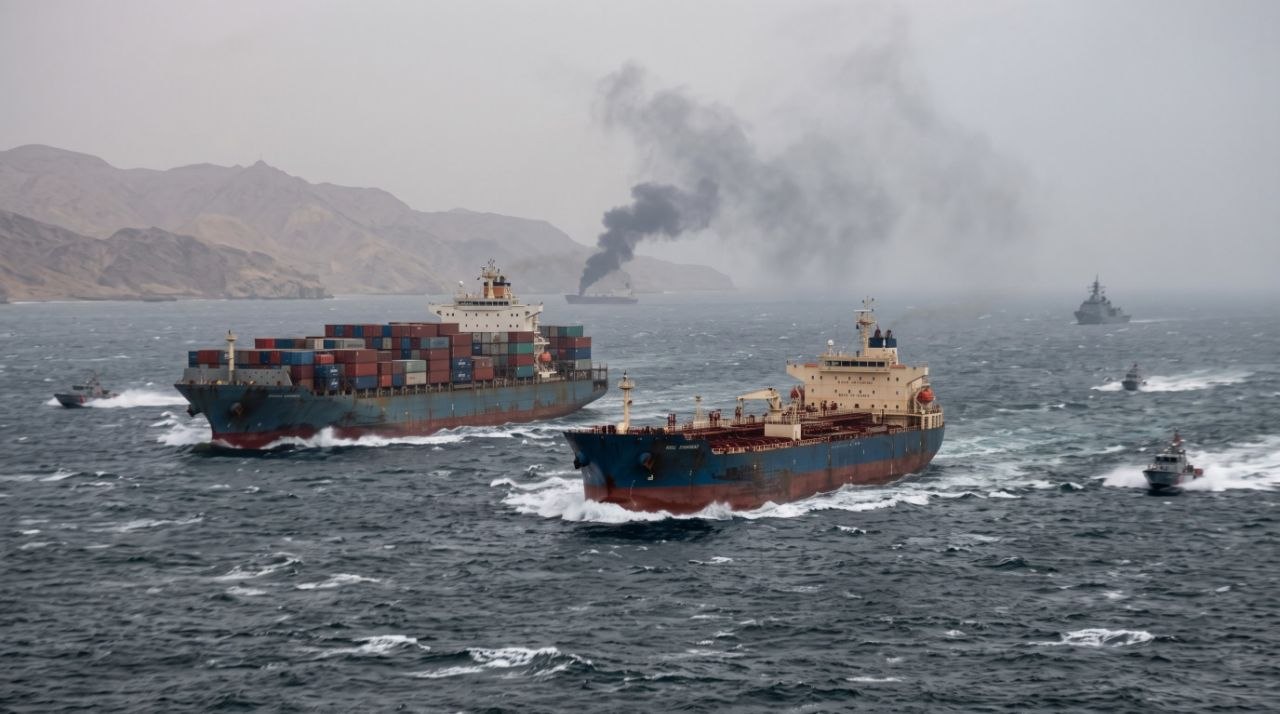
Multiple cargo vessels have sunk in the Strait of Hormuz following a sharp and unprecedented escalation in Iranian military attacks on commercial shipping in the vital Middle Eastern waterway. Maritime security agencies and regional monitors confirmed that at least two cargo ships went down within a 24-hour period, intensifying a violent month that has severely disrupted international trade and crude oil flows.
Escalation in the Strait of Hormuz
Pakistan’s National Hydrographic Office, which monitors regional maritime traffic, reported that two Emirati cargo ships—identified as the GFS Pride and the Cape Dao—sank after being struck in the strategic chokepoint. The Maritime and Port Authority of Singapore confirmed that the Singapore-registered GFS Pride was attacked while transiting the strait on Tuesday. Singaporean authorities condemned the incident, calling the strikes unprovoked, unjustifiable, and a direct breach of international law.
Maritime security firms note that these sinkings represent a dramatic and dangerous escalation in attacks not seen since the conflict began. According to tracking data from the United Kingdom Maritime Trade Operations (UKMTO) and European security sources, at least 24 foreign vessels have been targeted and hit by Iranian forces during the month of October alone. Between October 6 and October 14, security centers recorded 15 separate attacks, with 11 of those occurring in just a four-day window.
Impact on Global Oil Flows
The surge in military strikes has severely choked commercial navigation through the crucial energy corridor. Data from analytics firm Kpler revealed that oil flows through the Strait of Hormuz plummeted sharply, with only 2.9 million barrels of oil carried through the waterway on October 11. This drop stands in stark contrast to figures from just days earlier on October 8, when nearly 20.8 million barrels passed through the strait, well above the pre-war daily average of 17.1 million barrels.
Industry analysts indicate that Iran has amplified its surveillance, drone deployments, and marine radio intimidation tactics to deter commercial shipping and disrupt a recent rebound in crude oil exports.
Conflicting Claims and Investigation
Iran’s Islamic Revolutionary Guard Corps (IRGC) claimed responsibility for an explosion involving a container ship, alleging via state media that the vessel was carrying contraband and exploded after striking a naval mine on an unauthorized route. Footage published by the IRGC depicted a container ship carrying 2,500 containers sinking south of the strait.
However, independent maritime security firms, including Marisks, stated there is no verified evidence confirming that a naval mine caused the GFS Pride to sink. Security analysts cautioned that Tehran’s statements align with an ongoing psychological operations campaign designed to generate fear, maximize uncertainty, and discourage commercial vessels from entering the waterway.