
Henri Kagan and Kenso Soai Win 2026 Nobel Prize in Chemistry
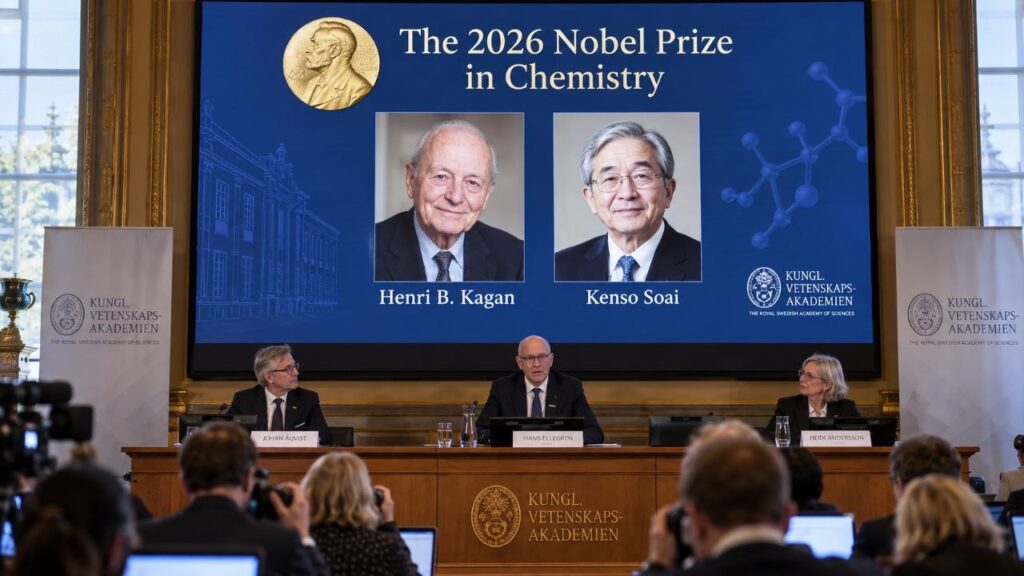
The 2026 Nobel Prize in Chemistry has been awarded to Henri B. Kagan of France and Kenso Soai of Japan for their revolutionary contributions to mirror chemistry and asymmetric organic synthesis.
Announced on Wednesday by the Royal Swedish Academy of Sciences in Stockholm, the prestigious prize recognizes the two scientists for their discovery of non-linear effects and autocatalysis. According to the Nobel committee, their findings solved a century-old chemical mystery regarding how homochirality can emerge spontaneously in nature.
Pioneering Work in Mirror Chemistry
Many molecules, including essential biological building blocks like amino acids, exist in two distinct forms that are non-superimposable mirror images of each other, much like human hands. While living organisms typically rely on only one of these mirror variants, creating just a single specific version in a laboratory setting has historically presented a major challenge for scientists.
Henri Kagan, affiliated with the Université Paris-Sud in France, and Kenso Soai, associated with the Tokyo University of Science, developed groundbreaking methods to address this fundamental problem. Kagan and Soai pioneered research that figured out how to selectively create single mirror-image molecules through asymmetric organic synthesis. The famous “Soai reaction” is named in honor of Soai’s experiments demonstrating these unique chemical pathways.
Impact on Pharmaceuticals and Modern Science
The committee highlighted that the laureates’ discoveries have been decisive for chemists developing specialized reactions to manufacture pharmaceuticals, fragrances, flavors, and advanced materials. Because the biological activity of many drugs depends heavily on their specific molecular handedness, the ability to control asymmetric synthesis precisely is crucial for modern medicine and drug development.
The Nobel Prize includes a diploma, a gold medal, and a shared prize sum of 12 million kronor, equivalent to approximately $1.2 million USD. The announcement marks another major milestone in international scientific recognition, celebrating decades of dedication to understanding the fundamental geometry of molecules.