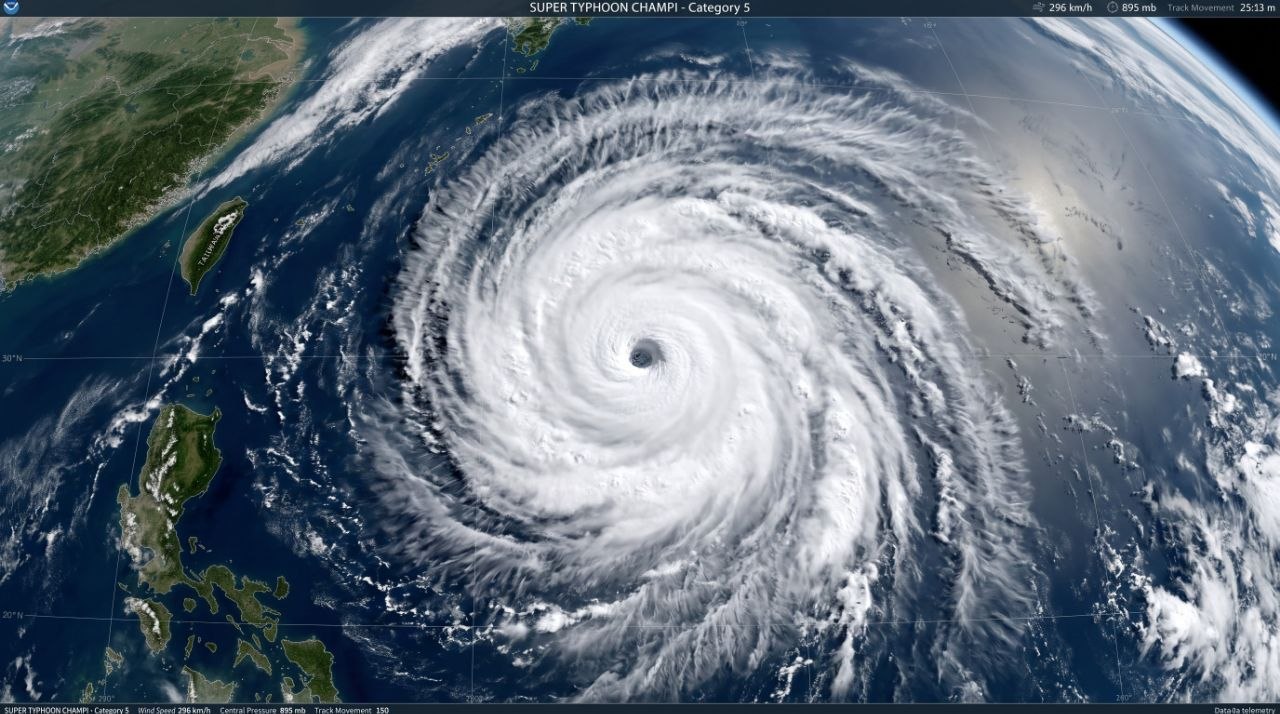
Taiwan has announced the suspension of stock exchange trading and the closure of schools across most areas as Super Typhoon Champi tracks toward the island. The powerful storm, which previously reached Category 5 strength, is expected to bring severe disruptions, flight cancellations, and torrential rainfall to the region.
According to the U.S. Joint Typhoon Warning Center, Typhoon Champi was located approximately 713 kilometers southwest of Japan’s Okinawa and was forecast to pass closest to northern Taiwan late Friday into Saturday. Authorities across the island have implemented emergency closures and safety measures to protect residents from the approaching severe weather.
Strongest Storm of 2026
Before threatening Taiwan, Champi made headlines across the globe as the strongest tropical cyclone of 2026. The storm achieved peak maximum sustained winds reaching approximately 185 miles per hour over the Philippine Sea, earning the equivalent status of a Category 5 hurricane or super typhoon.
Data from NASA’s MODIS instrument on the Aqua satellite and tracking agencies confirmed that Champi became the 10th storm in the northwest Pacific Ocean to reach super typhoon strength this season—double the long-term seasonal average and just shy of the record 13 storms recorded in 2015 during a comparable El Niño pattern. Earlier in its lifecycle, the system battered Guam as a destructive Category 4 storm before rapidly intensifying over open waters.
Broader Impact Across China and Japan
As Champi continues its trajectory across the Western Pacific, its impacts extend well beyond Taiwan. Forecasters note that the system is expected to maintain typhoon intensity while brushing the eastern coast of mainland China over the weekend.
The China Meteorological Administration warned that the storm’s outer bands will deliver heavy downpours to major metropolitan areas, including Shanghai and parts of Zhejiang province. Following its brush with the Chinese coastline, meteorological agencies project that Champi will curve northeastward toward Kyushu in southwest Japan, prompting regional emergency management teams to monitor the storm’s shifting path closely.