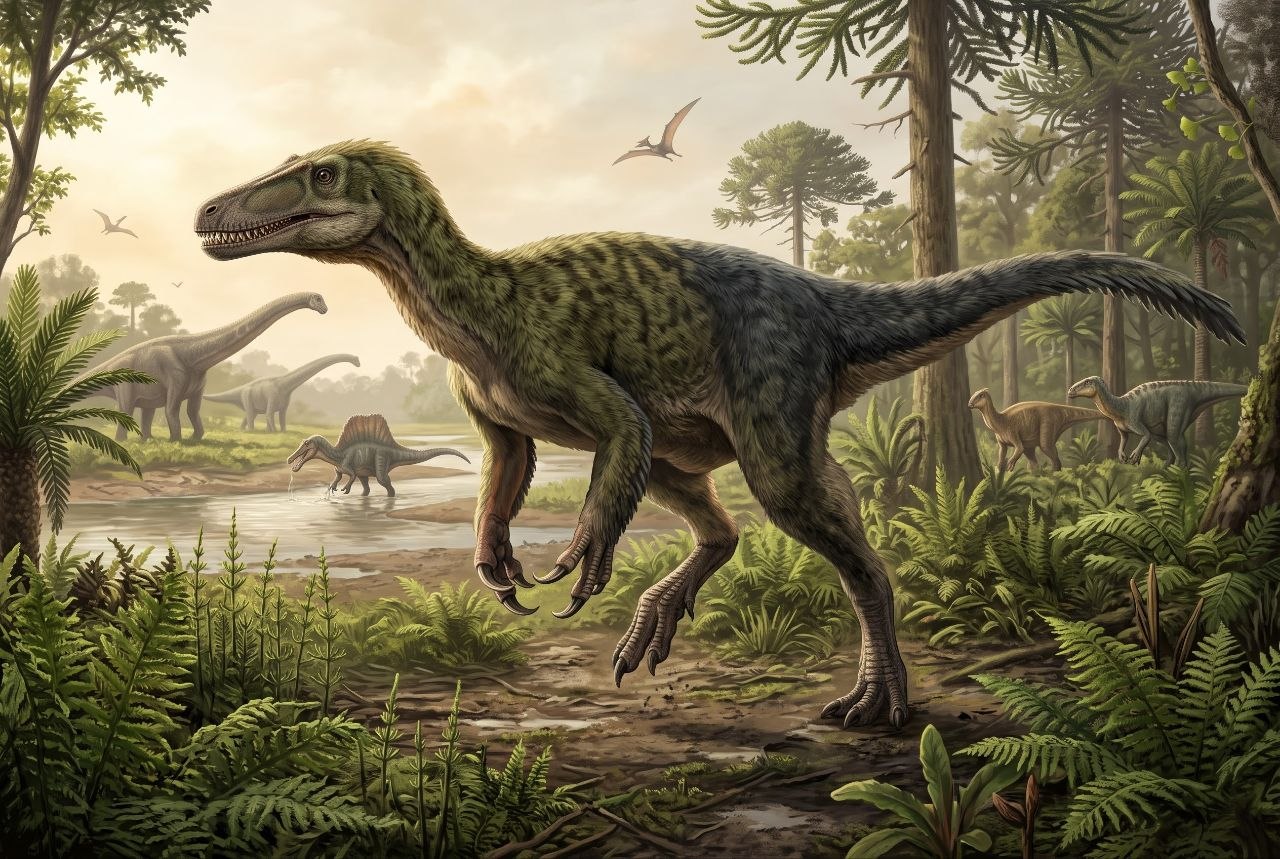
Scientists have identified a brand-new dinosaur species from a fossil that sat overlooked in a museum drawer for nearly a century. Named Invictibellatrix amberina, the tiger-sized predator is a distant cousin of the famous Tyrannosaurus rex and lived approximately 120 million years ago on England’s Isle of Wight.
The remarkable discovery was detailed in a study published in the journal Royal Society Open Science by researchers including Morrison and Barrett. Rather than emerging from a fresh excavation on the fossil-rich island, the breakthrough began with a single piece of a braincase stored quietly inside the Natural History Museum.
A Hidden Megaraptoran From the Isle of Wight
The fossil was originally collected decades ago as part of a batch of roughly 1,000 specimens found by Reginald Walter Tooley on the Isle of Wight. For nearly 100 years, the chunk of skull remained unstudied in museum archives until researchers utilized modern technology to examine it. Scientists performed a CT scan to build a precise 3D model of the skull fragment, comparing its unique features against other two-legged carnivorous dinosaurs such as tyrannosaurs, spinosaurs, and raptors.
The analysis confirmed the specimen belonged to an entirely new species of megaraptoran—a group of nimble, bipedal carnivores closely related to the lineage that spawned the T. rex. While T. rex relied heavily on its massive jaws to take down prey, megaraptorans hunted differently, using powerful arms and long, curved claws to capture meals.
Researchers note that Invictibellatrix amberina was roughly tiger-sized, standing as human-sized rather than matching the colossal proportions of later tyrannosaurs. Scientists joked that humans would have made ideal prey for the agile predator, noting that a T. rex might have ignored humans for being too small, whereas the megaraptoran would have actively pursued them.
Filling a Major Evolutionary Gap
The discovery carries profound significance for paleontologists trying to map the migration and evolution of megaraptorans. Scientists previously suspected that these predators originated in Asia and traveled across Europe before eventually reaching southern continents like South America and Australia, where some descendants grew as heavy as elephants. However, Europe previously lacked a definitive fossil to prove this geographic stepping stone.
The identification of the Isle of Wight braincase successfully bridges that evolutionary gap. The genus name, Invictibellatrix, translates to “unconquered female warrior,” honoring how megaraptorans eventually rose to become dominant apex predators in southern regions. The species name, amberina, pays tribute to both the amber discovered in the geological strata of the Isle of Wight and a female name, merging geological history with scientific optimism.
Experts emphasize that the find underscores the immense value locked inside historic museum collections. Despite more than two centuries of active fossil hunting making the Isle of Wight a world-famous dinosaur goldmine, researchers continue to uncover hidden treasures sitting right in front of them.