
First Nuclear Clocks Developed in Vienna and Beijing
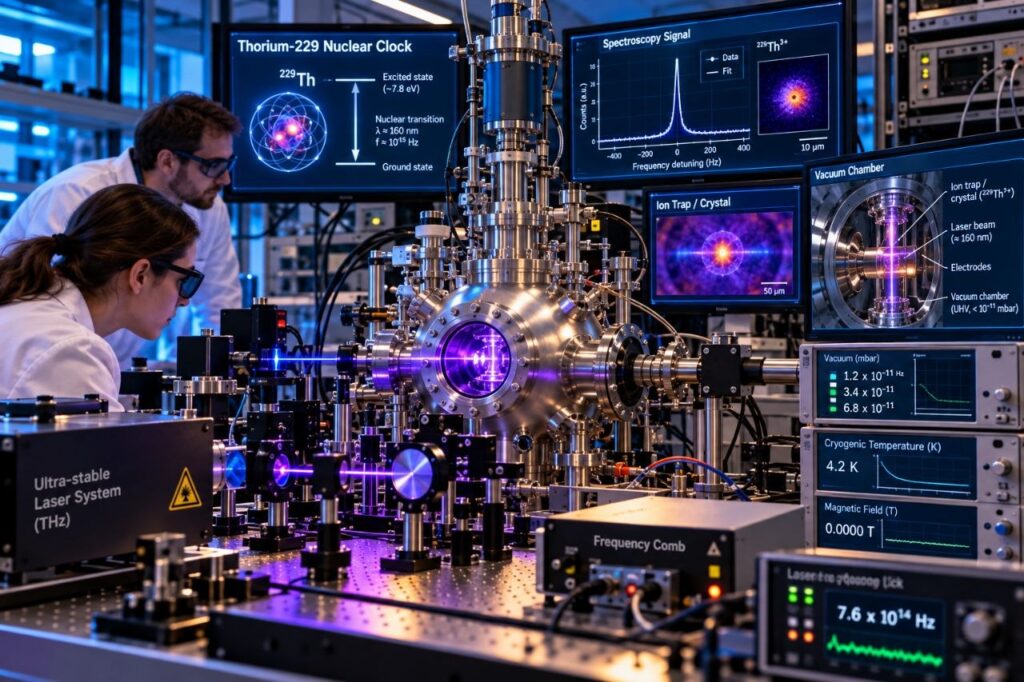
Timekeeping has officially entered a new era after two independent scientific teams, located in Vienna and Beijing, successfully built and operated the world’s first working nuclear clock prototypes. Published in the scientific journal Nature, the milestone achievement transitions precision measurement from traditional atomic electron transitions to the core of the atom itself.
Traditional atomic clocks measure time by tracking changes in an atom’s electrons. In contrast, the newly developed nuclear clocks use a laser tuned to a specific frequency where a thorium-229 nucleus flips between two energy states. Because atomic nuclei are significantly smaller and less affected by external electromagnetic disturbances than electrons, this method holds the promise of exceptional stability and accuracy.
The Thorium-229 Breakthrough
Squishing or manipulating atomic nuclei typically requires an enormous amount of energy, making nuclear timekeeping exceptionally difficult. However, the rare isotope thorium-229 serves as an exception. Researchers at the Vienna University of Technology (TU Wien) and Tsinghua University in Beijing independently utilized thorium-229 isotopes trapped inside calcium fluoride crystals, manipulated via vacuum-ultraviolet lasers, to establish a stable frequency reference.
While both teams successfully demonstrated operating prototypes, comparisons of their stability revealed notable differences. According to the published research, the prototype developed by the Chinese team in Beijing is roughly six times more stable than the model built by the Vienna team. Despite their groundbreaking nature, both current prototypes still fall short of the precision offered by the world’s top existing atomic clocks.
Future Implications for Physics and Navigation
The successful independent development of these nuclear clocks by two separate international teams has been welcomed by the scientific community as strong evidence that the underlying technology is sound. Researchers note that further refinement could eventually revolutionize GPS navigation, telecommunications, and fundamental physics research.
Despite the excitement surrounding the breakthrough, scientists emphasize that substantial developmental work remains before nuclear clocks can replace commercial atomic standards. As frontier science continues to advance, these initial prototypes represent a fundamental stepping stone toward a more stable and robust global time standard.