
First Thorium-229 Nuclear Clocks Developed in Beijing and Vienna
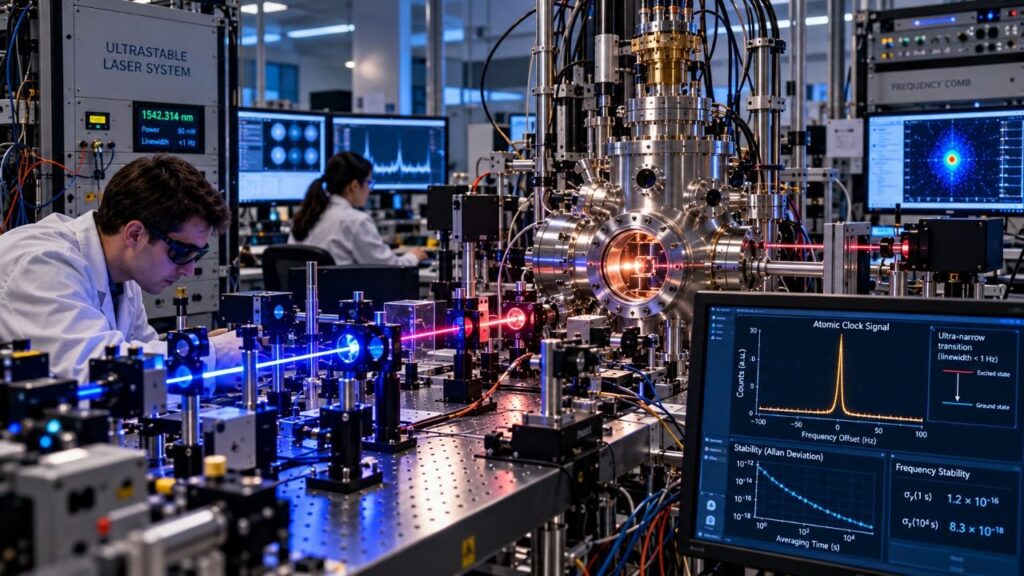
Scientific teams working independently in Beijing and Vienna have successfully developed the world’s first two operating thorium-229 nuclear clocks. Initial results published in the journal Nature reveal that the Chinese timepiece demonstrates roughly six times the stability of the device built in Vienna, marking a major milestone in high-precision measurement.
Unlike traditional atomic clocks that rely on the steady rhythm of electrons whirling around an atom’s nucleus, these radical new devices use thorium-229 nuclei embedded in crystals. By tuning into the steady rhythm of the atom’s core, the revolutionary clocks offer unprecedented precision and stability.
Global Competition and Scientific Milestones
When scientific reports initially highlighted the separate development of the two devices, researchers characterized the endeavor as a fierce yet friendly global competition. The latest studies published in Nature provide deeper insight into the performance and reproducibility of the breakthrough instruments.
According to the published findings, the Beijing research team—led by Tsinghua University—demonstrated that two crystals grown separately successfully kept the exact same time. Scientists note this reproducibility is a crucial sign that nuclear clocks can be reliably manufactured and scaled for future technological applications. Meanwhile, the Vienna team, featuring researchers from TU Wien, utilized its newly developed clock to actively hunt for dark matter, though those initial searches did not yield a detection.
The Future of Precision Timekeeping
The successful operation of thorium-229 nuclear clocks opens new frontiers in fundamental physics, navigation systems, and telecommunications. Because nuclear transitions are far less sensitive to external electromagnetic interference than electronic transitions in standard atomic clocks, nuclear clocks promise vastly superior long-term stability.
As research teams continue to refine their designs and explore practical applications, the international scientific community anticipates further breakthroughs in quantum metrology and fundamental physics exploration.